Good news for fellow chocolate lovers out there!
This article from Medscape shows promising results that eating chocolate may have the same effect as taking an aspirin a day!
"Chocolate Has Antithrombotic Effects Similar to Aspirin"
Martha Kerr
November 17, 2006 (Chicago) — Subjects enrolled in the Genetic Study of Aspirin Responsiveness (GeneSTAR) inadvertently helped Johns Hopkins University researchers measure chocolate's inhibition of platelet function and show that eating chocolate slows clotting time. The findings may explain how chocolate and cocoa-containing foods exert a cardioprotective effect.
A group of 139 healthy individuals did not eliminate chocolate from their diet.
Senior investigator Nauder Faraday, MD, associate professor of anesthesia and critical care medicine at Johns Hopkins University in Baltimore, Maryland, told Medscape that "chocolate was just one of those things this group couldn't give up."
The subjects were ejected from GeneSTAR proper and were not randomized in the aspirin assessment phase of the study. But Dr. Faraday and colleagues took advantage of the subjects' noncompliance to assess chocolate's previously demonstrated role in cardiovascular risk reduction, using the same platelet function analyzer test employed in the GeneSTAR study.
The investigators measured agonist-induced platelet activation in the presence of shear and calculated time to closure in the system by a platelet plug. Platelet activation was also assessed on urinary excretion.
Chocolate consumption caused a significant increase in time to closure, but remained within the normal range, the investigators announced here this week at the American Heart Association 2006 Scientific Sessions.
"Chocolate, even in small amounts, was an independent factor in inhibition of platelet activation," Dr. Naraday said. It extended closure time, regardless of age, sex, smoking status, body mass index, systolic blood pressure, total cholesterol level, fibrinogen levels, or von Willebrand factor.
"The magnitude of the effect was quite small," Dr. Naraday emphasized. Chocolate had the same type of effect as aspirin, but by a factor of 5 to 10 times less, according to the assay used in the GeneSTAR study, he said.
Elliott Antman, MD, professor of medicine at Harvard University in Cambridge, Masssachusetts, told Medscape that he found the results intriguing. "It might help explain the tremendous variability among patients to platelet inhibition, particularly as seen in response to aspirin."
Dr. Naraday pointed out that "any time you shift the balance away from thrombosis, you set up a situation with the potential for increased bleeding time and other risks, but I don't think this is a big problem with eating chocolate!"
Dr. Faraday's study is funded by the National Heart, Lung, and Blood Institute of the National Institutes of Health. Dr. Antman reports no relevant financial relationships.
AHA Scientific Sessions 2006: Abstract 4101. Presented November 14, 2006.
Thursday, November 30, 2006


On Mediation Again
I wrote an entry about Mediation May 25th this year titled On Mediation. I was very skeptical about the workability of such a process here at that point of time.
In today's Today Online, this process is outlined & will come into effect next year. I think it is a good first step to take in trying to tackle the increasing numbers of complaints lodged against medical practitioners & healthcare institutions.
Now doctors can say 'sorry'
However, I am still skeptical as to how long it will take for the mindset of doctors & patients to change from one of blame & shame to one of openess & mutual understanding. As doctors, we have been so afraid of being open to admitting to mistakes because of the fear of litigation that I wonder how long it will take for us to embrace this new process.
And in addition, within our own community, this punitive culture is still prevalent enough to prevent most of us from owning up to honest mistakes. How many of us have, as junior doctors, been made to feel absolutely fearful & ashamed by our seniors when they belittle us for our lack of knowledge or skill?
Yup, this is a good first step. But I still see a rather long flight of stairs ahead of us...
In today's Today Online, this process is outlined & will come into effect next year. I think it is a good first step to take in trying to tackle the increasing numbers of complaints lodged against medical practitioners & healthcare institutions.
Now doctors can say 'sorry'
A freer, less painful approach to medical negligence cases
Loh Chee Kong
cheekong@mediacorp.com.sg EARLY last year, Mr Surender Singh's wife died after she donated one of her kidneys to him. He still doesn't know why. He hasn't heard an explanation or an apology from the doctors concerned. The hospital is being fronted only by its lawyers — and for good reason.When something goes wrong, doctors worry that anything they say might be used against them in court, said lawyer Amolat Singh, who represents Mr Surender Singh.Starting next year, an initiative by Chief Justice Chan Sek Keong could change the complexion of medical negligence cases. All parties can meet before a case begins; patients or their relatives can find out exactly what happened; and, if necessary, doctors can say sorry.More importantly, everyone can speak freely, because the information exchanged cannot be used in court.In fact, experts said that if the move takes off, there could be less need to go to court at all. The air of mistrust can be cleared, and if an honest mistake has been made, the matter can be settled without relying on expensive litigation.Under this new protocol, once someone has paid a fee of between $75 and $100 for his medical documents, he should get a response from the hospitals and doctors within six weeks.After that, a face-to-face meeting can be arranged within two months.An average of nine medical negligence suits have been filed here each year since 1998. Most get settled at the Subordinate Courts' Primary Dispute Resolution Centre without going to trial.The new "open disclosure" policy could ease the pain further. Eventually, said Subordinate Courts Registrar Toh Han Li, it might even be applied to cases in the High Court, which hears civil suits involving claims of more than $250,000.Both doctors and patients could gain. More understanding — and fewer cases going to court — could bring down premiums on insurance policies for doctors and lower medical costs.Patients also know how hard it is to prove outright medical negligence. One of the last notable cases where a patient sued successfully was in 2001, when a botched operation shrank an American national's testicles to the size of a child's.Some patients get unnerved by high legal fees, while others find it difficult to find a medical expert to testify against his peers, said lawyer Peter Low.Doctors, caught in a legal tangle, get equally frustrated.Said Dr Chong Yeh Woei, a general practitioner: "When you get involved in a legal process, the first thing you do is to consult your lawyers and do what they tell you to. "You might want to say sorry — and sometimes, it's all the other party wants. But by saying sorry, you are admitting liability and guilt."Or, as Dr Melanie Billings-Yun, a consultant in conflict resolution, put it in her February lecture to a roomful of Subordinate Courts officials: "The adversarial system is based on faults. But in 80 to 85 per cent of malpractice cases, there is no fault to be found. "If doctors are forced by their lawyers or insurance companies to treat every adverse outcome as a dirty secret, is a patient or his family being unreasonable to imagine that fault must indeed lie behind a stone wall of silence?"With an open disclosure policy, doctors and nurses will no longer be made to hide as if they were criminals ... more importantly, they will find that their words have the power to heal their own wounds."
cheekong@mediacorp.com.sg
And in addition, within our own community, this punitive culture is still prevalent enough to prevent most of us from owning up to honest mistakes. How many of us have, as junior doctors, been made to feel absolutely fearful & ashamed by our seniors when they belittle us for our lack of knowledge or skill?
Yup, this is a good first step. But I still see a rather long flight of stairs ahead of us...
Bizarro
Been getting really strange dreams this past week or so, possibly due to my subconscious mind reacting to the stress of the impending move.
Last week, I dreamt that my sister was married to Hugh Jackman! Not withstanding the fact that Hugh "Hottie" Jackman is already married, I really really really REALLY cannot imagine my sister falling for him. I do admit that in my dream, I was a trifle jealous (married woman that I am, I confess to a little crush on this hunk of a dude). The fact that I watched "Happy Feet" (in which HJ did the voice of Memphis, & was the first time I had heard him singing - lovely voice - wish I could have caught him on Broadway doing "The Boy From Oz"...but now I digress) last week probably contributed to the generation of this dream.
Then last night, I dreamt that I (Mary Jane Parker) went on some kind of weird vacation with Peter Parker (aka you-know-who) at this dumpy little motel located in what felt like a really bad part of LA. Every corner we went, there were these Hispanic gangs eyeing us, looking like they were about to attack us any minute....and dear old Peter refused to use his Spidey powers to intimidate these people!!! And I was quite upset by that. Bizarre. I think I have Spiderman on my mind after watching the latest trailer for Spiderman 3, which looks to be superb.
Maybe I am subconsciously calling for help from my superhero idols - Wolvie & Spidey - to help me pack & move house!!! Especially since my husband will be away for 2 weeks preceding the pack out, on a business trip & only arriving back here THE DAY BEFORE THE MOVERS COME!!!
Maybe tonight I'll dream of the whole X-Men team...
Saturday, November 25, 2006
Organs For Sale?
There were two articles recently about kidney transplants.
The first was a heartwarming one about a 5 way swop of kidneys so that 5 needy patients with 5 willing but otherwise non-compatible donors, would be able to receive suitable kidneys. With the shortage of donors, this unconventional method of transplanting kidneys was a great success. Although it must have been a logistical nightmare, all came together with a resulting happy ending.
The second is about the legalisation of sales of kidneys in Iran. This is undeniably controversial. The question of ethics comes up. But if you were the patient, & had the means to pay for such a procedure, would you do so? Having said that, would this mean that only those who can afford it will get the kidneys they need while the poorer patients will have to wait till an available donor comes up, or till they die?
As doctors, our first response to such commercialisation of organ transplantation would most likely be that of disapproval. The idea of selling organs for money is a distasteful one. Whenever money comes into play, there is always the chance that eventually, the bottom line will become more important than the patient's health (IMHO, this is already happening - look at how aesthetic medicine is booming & how MHC's have affected the way medicine is practised).
But as humans, how do we condemn someone who only wants to live to see his/her children grow up & grow old with the one they love?
This is a complicated issue indeed, & something that we need to step back & look at from different perspectives...no easy answer to it.
Friday, November 24, 2006
Separation Anxiety
I think emotionally, I haven’t yet come to terms with the fact that we will be leaving Singapore in just over a month. I’ve been so busy taking care of the practical side of things like arranging moving dates, selling stuff etc. that I really haven’t had time to ruminate over what this move will mean.
This will not be the first time that I am moving away. Fourteen years ago, we left this island with an infant in tow. I was too excited about living in a new place & meeting new people to really be overcome with any kind of sadness over leaving. Definitely I missed my family & friends. But I was too busy with having to take care of a young child, & settling down to wallow in any form of misery (not that I am the wallowing kind in the first place!)
This time around, both my kids are more independent & don’t need round the clock care like 14 years ago (!!!). I will have more time to myself, since domestic help is readily available in China. I certainly don’t plan to immerse myself in self-pity. I hear that expats there make friends more easily than here in Singapore, for some reason. Hopefully that will prove to be true, as I find that the older I get, the harder it is to establish firm friendships like the kind that endures since childhood or college. That kind of comfort level where you can meet each other & feel immediately at home even though you have been apart for a number of years…that is the kind of intimacy that close & old friends share that is hard to capture in new friendships.
I know for sure that I will miss being able to visit with my parents/siblings/best friends when I feel like it. And I will miss the fluid efficiency of the way things are run here (despite our frequent complaining!), not to mention local hawker fare.
But with technology, Mom/Dad/Sis/Bro are just a phone or Skype call away, we can even use the webcam to have face-to-face conversations without having to worry about long distance phone bills. And a six hour flight is not that far away for one to visit or be visited by family.
Monday, November 20, 2006
busy, busy, busy
please excuse my absence. it's been a busy week, including a rockappella concert, and a short trip up to kl to attend a wedding of the son of an old friend of my mom's. talk about lifestyles of the rich & famous...this wedding was the wedding of the year in malaysia (imho). even the agung (king of malaysia, for the uninformed) attended. blessing ceremony by the lakeside; goody bags with amazing pressies for all the guests; carnival-like entertainment with magician, jugglers, pretty girls with pythons draped around their necks & parrot/parakeet on their fingers; hired band from singapore; beautifully made videos of the couple's love story (this beats, hands down, the usual slideshows played to cheesy romantic love songs that one sees at the "normal" wedding dinners) including the proposal video involving a mini cooper...you had to see it to believe it.
of course, no trip to kl is complete without the ritual rounds of yummy hawker food (wantan mee, char kuay teow, mee yoke, chee cheong fun, hokkien mee all cooked in ways unique to kl)...i think my arteries are semi clogged from all the cholesterol i ingested over 3 days!!!
now that i am back, it's back to the overwhelming task of preparing for the move. add to the list of things to do(refer previous entry):
note: no caps in this entry - quite liberating. maybe i should try no punctuations one day, but then it would probably be too hard to read. :)
of course, no trip to kl is complete without the ritual rounds of yummy hawker food (wantan mee, char kuay teow, mee yoke, chee cheong fun, hokkien mee all cooked in ways unique to kl)...i think my arteries are semi clogged from all the cholesterol i ingested over 3 days!!!
now that i am back, it's back to the overwhelming task of preparing for the move. add to the list of things to do(refer previous entry):
- choose furniture for housing (not easily done with pictures sent via email)
- get influenza shots for family (hep a & typhoid already done; don't think we are at risk for jap encephalitis nor rabies so will pass on that for now...will have to warn kids to stay away from stray animals & rabid looking humans!)
- get vital medical checkups done before leaving (ladies above 40, don't forget your annual mammograms!)
- sell furniture that we are not bringing with us (almost done - surprisingly, lots of takers for 2nd hand stuff)
- finish christmas shopping
note: no caps in this entry - quite liberating. maybe i should try no punctuations one day, but then it would probably be too hard to read. :)
Saturday, November 11, 2006
Aliendoc's Things To Do Before We Move
1. Sell home - check
2. Sell car
3. Decide what belongings to ship to new home
4. Decide what belongings to sell
5. Decide what to put in storage
6. Buy winter clothing for kids (IMPORTANT!)
7. Forward mail to either mother or sister’s address
8. Change address of credit cards/banks etc
9. Terminate some credit card accounts
10. Inform SMC of move - check
As can be seen only 2 out of the top 10 things to do before we move have been checked off. Which means that I STILL HAVE A LOT TO TAKE CARE OFF!!!
AAAARRGGGHHH!!!!!
Wednesday, November 08, 2006
On Being Parents
A couple of days ago, a toddler’s big toe was ripped off when it got caught on the side of an escalator. She was wearing rubber clogs (you know, the one that is damn ugly but damn comfortable). It was highlighted that these clogs are very pliable & hence would get caught & pulled into the gap between the side of the escalator & the step.
Hopefully, the clogs won’t be made the scapegoat of this kind of accidents. If you think about it reasonably, it would be quite difficult to edge your foot to the side of the escalator so that it would get caught. But knowing children, they have a propensity to stick things where they don’t belong. I have had to, on many occasions during my A & E posting, extract a variety of foreign objects from various orifices in the head of a number of children.
My point is this: an adult (usually the parent) is supposed to supervise the behavior of children, especially those under the age of 5. They are supposed to teach them that certain actions are dangerous, and that certain kinds of behavior are unacceptable in civilized society. They are supposed to teach them how to do certain things like crossing the road, going up & down stairs, going up & down escalators. Obviously, we don’t expect the kids to pick up on the safe way of doing these things immediately. You would expect the adult to hold the child’s hand, for example, while crossing the street (I still try to do that to my 12 year old, to his chagrin ☺). You would expect the adult to watch the child & admonish him if necessary, if the kid starts misbehaving on an escalator (like trying to stick his/her foot into the crevice between the step & the side…I don’t know if this actually happened in the above mentioned case, but it could have).
Parenthood is a full-time job. You need vigilance, care, and attention on top of TLC. It’s easy to love a child (especially your own☺!) but it is hard to keep them safe 24/7.
When my kids were little, I had child-proof locks on all my kitchen cabinets/drawers; child-proof covers on the knobs of the stove; a plastic shield attached to the front of my stove to prevent inquisitive fingers from reaching up & pulling a pot of boiling liquid on top of his head; child-proof gates preventing the kids from getting into the kitchen while Mommy was cooking (no maid while living in the US – I survived ☺); child-proof gates on the bottom AND top of the staircase, bumpers on the corners of my coffee table to prevent accidental bumps & scalp lacerations.
Whenever we ate out, I automatically would move breakable crockery or glasses full of liquid or hot dishes out of reach of grasping hands…I still do this if I happen to be dining in the company of small children!
Locally, many children are being looked after by domestic helpers. I think many parents become very lackadaisical when the time comes that they have to take care of their own child (eg. on the maid’s day off). They need to wake up, step up to the plate & take responsibility, not only for keeping their children safe, but also in teaching them how not to behave like hooligans.
Tuesday, November 07, 2006
“I yam what I yam!” (from Popeye the sailorman)
I read a report in the newspaper today about a 16 year old boy, D., who was convicted of robbery & given a 5 year jail sentence with 24 strokes of the cane (which is the maximum allowable). He had previously been sent to a juvenile facility for “reformative training”. D. himself shouted at the judge during his trial, threatening him & saying that this training was useless & that he should be sent to jail instead.
At first glance, the picture of this boy shows a typical face of a teenager. But look closely at his eyes & you see the vacuous expression, almost bereft of emotion. Who was it that said, “The eyes are windows into the soul”? How true.
This boy (yes, I consider him a child) is only 2 years older than my elder son. He started off in life with less than desirable circumstances - parents divorced, with dad apparently abandoning the family when he was just an infant. He is supposedly of below average intelligence as well – he has been faced with so many disadvantages in life already, I guess we shouldn’t be surprised with the outcome.
We are the result of our life experiences. As individual beings, we start off as a mass of organic material, with certain genetically pre-determined qualities. However, how these “lumps of clay” are shaped & what the end result is, is due to a complex interplay of factors including parental influence, family relationships, environmental push & shove and to a small degree, sheer luck.
Many of our neuroses stem from these factors. Whether we have been nurtured or battered by these childhood experiences & familial relationships, will determine whether that lump of clay will turn out to be a work of art, or just a rock to be hidden out of sight. I believe that all of us have, to varying degrees, dysfunctional families. If severe, this would express itself as neuroses. I would be the first to admit that I have issues to work out, all stemming from the factors listed above. However, I don’t think I am neurotic (yet…although it is probably matter of opinion, depending on whom you ask!).
It is sad that D. ended up where he is now in his short life. The African proverb “It takes a village to raise a child”, made famous by Hilary Clinton, is so true.
I guess D.’s village failed him.
Tuesday, October 31, 2006
Snapshots from Beijing
We managed to find some time to take in some sights in Beijing while we were there, in between looking at houses & schools. Here are a few of the more interesting shots:
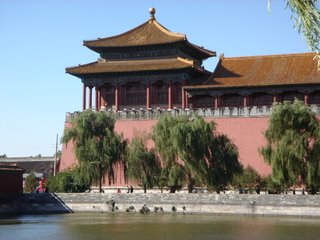
External View of the Forbidden City
Some of the buildings inside were closed off for repairs. A bit disappointing.
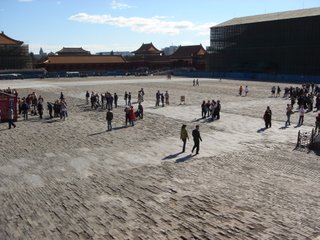
Square inside the Forbidden City
Notice the worn out stones on the floor. Looks familiar? I think I saw it (or a facsimile) in a Jackie Chan or Jet Li movie. Or in a trailer of a Chinese epic... Those stones have probably been there for hundreds of years. Uneven & bumpy, could be hazardous for walking if you are not careful.
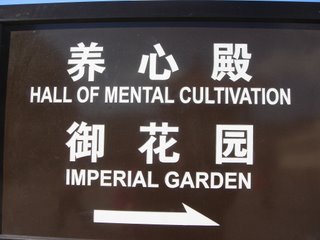
Speaks for itself!
The place to go to broaden your mind & expand your horizons!
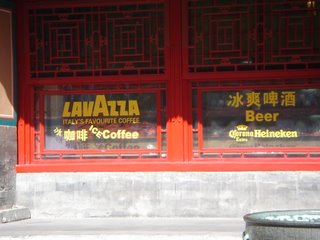
East meets West, Old meets New
Want a cuppa Java? How about a Heineken? All available in the Forbidden City!
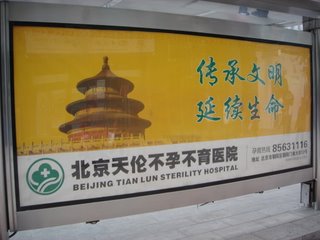
Ad on Bus Stop
This was an honest to God, true blue ad seen on the back of a bus stop along a busy street in downtown Beijing! I did a double take when I saw it. I guess this is the place to go if you want to become sterile? Looking at the Chinese words, I think it's for abortions & contraception (Chinese experts out there, jump in here to correct me if I am wrong).

Snacking in Beijing
Seahorse? Starfish? Bugs? Worms? How about live spiders (not in picture)?
I think I'll stick to satay or french fries, thank you very much. :P

External View of the Forbidden City
Some of the buildings inside were closed off for repairs. A bit disappointing.

Square inside the Forbidden City
Notice the worn out stones on the floor. Looks familiar? I think I saw it (or a facsimile) in a Jackie Chan or Jet Li movie. Or in a trailer of a Chinese epic... Those stones have probably been there for hundreds of years. Uneven & bumpy, could be hazardous for walking if you are not careful.

Speaks for itself!
The place to go to broaden your mind & expand your horizons!

East meets West, Old meets New
Want a cuppa Java? How about a Heineken? All available in the Forbidden City!

Ad on Bus Stop
This was an honest to God, true blue ad seen on the back of a bus stop along a busy street in downtown Beijing! I did a double take when I saw it. I guess this is the place to go if you want to become sterile? Looking at the Chinese words, I think it's for abortions & contraception (Chinese experts out there, jump in here to correct me if I am wrong).

Snacking in Beijing
Seahorse? Starfish? Bugs? Worms? How about live spiders (not in picture)?
I think I'll stick to satay or french fries, thank you very much. :P
Sunday, October 29, 2006
Scoop
After reading the mixed reviews received by this Woody Allen movie, I decided to go ahead & watch it anyway (OK, OK, I admit it...Hugh Jackson was a BIG draw for me ☺), & managed to convince my guys to come along with me.
We watched it at the new mega-movie theatre at the spanking new mall called Vivocity (we're still trying to decide whether to pronounce it as Vi-VOc-i-ty -which rhymes with velocity- or Vi-VOH-City - derived from the Latin word "vivo" meaning life, I think).
I'm glad we did watch it, although it didn't blow me away. It showed my kids that comedy needn't always be the slapstick & pie-in-my-face kind that is typical of Jim Carrey and the SNL alumni like Adam Sandler, Rob Schneider & Mike Myers.
The dialog was, well, typically Woody Allen-esque, with witty comebacks & self-deprecating humor although Mr Allen's frequent stuttering (whether intentional or not) got a bit stale & annoying after a while. Scarlett Johanssen showed her versatility with her portrayal of eager, naive journalism student, Sandra Pransky, hot on the heels of her first scoop. Hugh Jackman didn't really shine here, although he looked mighty fine in Speedos (*GRIN*).
Sidenote: we were very impressed with the movie theatre. We were in Cinema Europa which is supposed to have a bigger screen, & allow movie-goers to enjoy the movie in an elegant & intimate setting. It was indeed very comfortable, & more "high class" than the regular theatres (tickets DID cost $1 more); but I wished that the seats could have reclined a bit more.
Sigh...which reminds me that I AM going to miss movie-going when we are in China...
Oh, & by the way, my kids actually enjoyed the movie & found it funny! I guess they are smarter than I think...heeheehee...
Thursday, October 26, 2006
EEEWWW!!!
I came across this article on Medscape to which I subscribe. My very vivid imagination conjured up images I would have rather not imagined as I read it...ugh...read on, if you dare...
Circumcision, Religious Freedom, and Herpes Infections in New York City
Posted 10/17/2006
Howard Markel, MD, PhD
If you ever find yourself in the coffee line at a medical conference, be prepared to eavesdrop on a gaggle of doctors exchanging the medical equivalent of "war stories," wild tales of clinical misadventures and treatment plans gone awry. It was precisely at such a venue that I heard what easily qualifies as one of the strangest — and scariest — medical tale of recent times.
It actually began in 2004 when the New York City Department of Health received reports of 3 newborn, male babies who contracted herpes simplex virus (HSV-1). All of them required weeks of hospital care and intravenous injections of powerful antiviral medication. Tragically, one of them died from the infection.
Unlike a mere cold sore or an embarrassing, painful crop of genital blisters, herpes for a newborn is truly a life-and-death matter. Aggressive and relentless, the herpes virus can destroy an infant's brain in a matter of days. Every pediatrician who notices any type of blister on a newborn's body shudders as he contemplates whether its cause is merely an abrasive blanket or, far worse, a harbinger of a systemic infection with herpes.
But the story only gets stranger. Using a mixture of detective work and medical acumen, the New York City Department of Health figured out that all of these babies contracted herpes shortly after undergoing a ritual circumcision by the same mohel, the religious figure in the Jewish faith charged with conducting the ancient and spiritually important ceremony called a bris.
Under Jewish law, the mohel is required to draw blood from the circumcision site, ostensibly to remove what the Old Testament refers to as "impurities" and what we might interpret today as germs. The thought, back then, was that a flow of blood away from the circumcision site would carry these potentially dangerous entities away from the baby. But the traditional way to do this, a practice called Metzizah bi peh, calls for the mohel to use his mouth and suck out the blood.
To be sure, this peculiar means of viral spread remains rare. Nevertheless, there have been 11 cases of male babies who contracted herpes following circumcisions that included Metzizah bi peh reported over the past 5 years in New York, Canada, and Israel. In 2005, there were 4 infected babies in New York City and all of them were circumcised by the same New York-based mohel (who only recently was persuaded to take a prolonged vacation from his line of work).
According to Dr. Thomas Frieden, New York City's Commissioner of Health, coincidence is not an explanatory option. "There is no reasonable doubt that the practice of Metzizah bi peh has infected several infants in New York City with the herpes virus, including one child who has died and another who has evidence of brain damage," said Dr. Frieden.
Given that more than 70% of all adults 40 years of age or older are infected with the herpes simplex virus; that the mouth is the most common site of HSV-1 infection; and that most adults with oral herpes do not know whether they are infected, typically do not have symptoms, but can still spread the infection to others, one can begin to understand the potential public health problems associated with such a tradition.
Indeed, this is precisely why the Chief Rabbinate in Israel and the New York-based Rabbinical Council of America, which serves more than 1000 rabbis in the United States and Canada, began urging all mohels to avoid the potential spread of infection by using a tiny, sterile glass tube to draw the blood instead of putting their mouths directly on the circumcision wound. The overwhelming majority of mohels working today follow this interpretation of the custom.
Yet the ultra-Orthodox Hasidic Jewish community persists in adhering to ancient law precisely as it was written. That is, after all, what "orthodox" means. And despite the hedging and explaining by their less orthodox counterparts, Hasidic rabbis insist that performing the bris exactly as it was described in the Bible is essential to what it means to be Jewish.
So when the New York City Department of Health proposed a voluntary ban on the practice, the Hasidic community tersely told the government agency not to interfere in their religious beliefs or practices. Indeed, the ultra-Orthodox Hasidic community, one that has a great deal of political clout in New York City politics, has pledged to fight any health edicts restricting the ancient practice with the proverbial tooth and nail.
Even if such a law could be written, how would you enforce it? After all, the bris is almost always performed in the parents' home, out of the view of the health department or a police officer.
Certainly this means of contracting a deadly infection is rare. Only 7 cases of mohel-related herpes have been reported in New York since 1998, and each year there are 2000 to 4000 circumcisions performed in that city alone. But rare does not mean nonexistent. No one can deny that this practice presents a real and serious health risk.
Just as frightening, there have been reports of other Jewish parents who, while less exacting in their religious practices, hired ultra-Orthodox mohels without knowledge that they practiced the potentially risky Metzizah bi peh procedure.
Dr. Frieden, the same public health crusader who managed to get cigarettes banned from all public spaces in New York City, admits that negotiating the rocky shoals of this controversy represents the "most delicate issue I have had to deal with."
"My ideal would be to inform the community so that they stop doing this and a large part of the Jewish community has accepted it," Dr. Frieden explained to me in an interview. "But this issue is far from over and it is still going on among those who are most Orthodox. If it were simple, we would have dealt with it simply."
That's an understatement. It has been years since I studied Talmud, but I know what my Rabbi would have uttered in response to this quandary of Biblical proportions: "Oyyyy."
Howard Markel, MD, PhD, George E. Wantz Professor of the History of Medicine, Professor of Pediatrics and Communicable Diseases, Director of the Center for the History of Medicine, University of Michigan, Ann Arbor; author of When Germs Travel: Six Major Epidemics and the Fears They Have Unleashed (Pantheon Books)
Disclosure: Howard Markel, MD, PhD, has disclosed no relevant financial relationships.
Medscape Pediatrics. 2006;8(2) ©2006 Medscape
Wanderlust (II)
I’ve always wanted to see & experience new places. When I was young, I used to imagine myself under the Big Sky of Montana, or enjoying the sea breeze on the Greek Isles, or skiing the slopes of the Alps. Perhaps it was a presage of what my life has become as an adult with my own family.
We’ve moved multiple times in the last decade and a half, two of those moves halfway across the globe. I consider myself a global citizen, my ideas, perceptions, & values having been shaped (& still being shaped) by diverse & varied life experiences. An old classmate from Medical School commented recently that I have had a somewhat unusual life, compared to the rest of my cohort.
I don’t think this kind of life is for everyone. I know a few of my closest friends are befuddled at how I can do what I do. But it’s not that strange or unusual a lifestyle after all. There is a small percentage of the people of the world who are quasi-nomadic in nature. Their jobs bring them to different parts of the world, often far & vastly different from their home country. Their families are relocated every few years. Previously, these were mainly military families who went where they were directed to go. Now, with the globalization of so many companies, businesses are expanding to places all over the world, sending their senior managers to these places to help run their organizations. And these employees bring along there spouses & kids to unfamiliar environs.
Their kids are known as third culture kids. One usually finds these children in international schools, getting to know kids in the same shoes, from other cultures & ethnicities. And because they don’t live in their home country, they develop a unique culture of their own, assimilating views & opinions from their international friends.
I don’t think I would consider my kids TCKs. Half their lives were spent in their passport country, while the other half in their mom’s passport country. And part of the latter was spent assimilated in a local school while the other part in an international school. Perhaps a more suitable term would be “Different Cultured Kids”. I am not sure how this will affect them as adults. With our impending move to China, doubts & fears of settling into & living in such a different country arise, especially for my children, as they have to make new friends & get used to a new school. Heck, I will have to make new friends as well!!! And make do with less English movies/books/TV programs (sigh).
Despite how daunting the move may be, what I am sure of is that ultimately, their experiences & my own, will be unique and enriching. At least, we will be able to learn proper Mandarin!
Driving you crazy

And I thought driving in Singapore was bad.
I literally feared for my life while traversing the streets of downtown Beijing as a passenger as well as a pedestrian. This is what I learnt about traffic in Beijing:
A) Pedestrians DO NOT have right of way, no matter what color the little man is on the traffic light. It’s survival of the fittest as far as crossing the road is concerned. It seems like you almost need to have a death wish or at least faith that The Force Is With You. Even the pavements are not safe – you may suddenly find yourself leaping out of the way of a cyclist who decides that the pavement is a quicker (& less risky) way to get to his destination.
B) Horns in China are activated when you depress the brakes (& I suspect the accelerator as well). You honk when you need to let your fellow motorists/errant pedestrians/cyclist know to “Watch out, I am coming”/”Get out of the way”/”Move, you idiot”.
C) Cyclists are an entity unto their own – they have their own traffic rules which basically states that anything goes as long as you don’t get knocked down or don’t knock down anybody else.
Thank God I don’t have to drive when we move there.
Wednesday, October 18, 2006
goodbye, old friend.
just when i thought i was all cried out,
the tears start to flow again
trying to fill the void in our lives.
goodbye, old friend.
go in peace.
the tears start to flow again
trying to fill the void in our lives.
goodbye, old friend.
go in peace.
In The News
Pg H3, HOME Section, The Straits Times, October 18, 2006
Dispute Mediation helps both patients and dentists – Patients avoid legal bills and dentists pay less for insurance
by Salma Khalik
Hmm.
I didn’t realize that the Singapore Dental Association’s Ethics Committee handles mediation in patient-dentist disputes.
I wonder why the Singapore Medical Association doesn’t have a committee to do the same? Or at least facilitate the formation of a committee to do the same. I, for one, know that it is sorely needed.
Pg 23, World News, The Straits Times, Oct 18, 2006
Fast Track to Citizenship: Join the US military
This is an article taken from Reuters.
I find it ironic that PRs/immigrants in the United States are literally dying to take up US citizenship while Singaporeans & PRs here try all ways & means to get out of doing NS, or at least, to get their PES rating downgraded.
So much for patriotism, eh? It’s no wonder that the ICS responded to a reader’s suggestion to allow dual citizenship with this letter:
Oct 14, 2006
Singapore not ready for dual citizenship
I REFER to the letter by Mr Bertrand Teo Ming Shan, 'Can ICA be flexible in dual citizenship case?' (ST, Sept 27).
Dual citizenship is a policy that has to be considered carefully and thoroughly.
We have yet to reach the stage of nationhood where a Singaporean with a second citizenship would still retain his identity and loyalty to Singapore as his homeland wherever he goes, with his second citizenship being only of secondary importance.
Lim Jing Jing (Ms)
Senior Public & Internal Communications Executive
Immigration & Checkpoints Authority
Pg 20, World News, The Straits Times, Oct 18, 2006
Disabled girl without a home.
This story is about a girl named Charlotte Wyatt who was born 3 months premature in October 2004. Her parents had fought in the courts to require that doctors provide artificial ventilation if her condition worsened. I guess they succeeded, because she is still alive, albeit with serious brain, lung & kidney damage. Her treatment apparently costs close to S$900 a day; she requires 3 litres of oxygen every minute; she is fed & medicated through a nasal tube. Her parents are now separated (apparently due to the strain of coping with this situation), & now, social workers are looking for foster parents to look after Charlotte as both mum & dad are unable to do so.
I had previously blogged about this issue of sustaining life at all costs as part of an earlier entry.
Is it worth it?
Live Cell Therapy???
And finally, I spotted an ad in the Mind Your Body section of the papers for an organization called Villa Medica Asia which is “one of the few approved clinics to administer the live cell therapy”. A google search revealed that indications for this therapy which involves injection of animal derived cellular material into the patient, includes a whole host of conditions, ranging from exhaustion to menopause to retarded development in children! Wow!
Hmm (again). I wonder how MOH/SMC/SMA will respond to this amazing & miraculous treatment.
Tuesday, October 17, 2006
Wanderlust (I)
We will pay a visit to our ancestral homeland this week, my husband, our sons & I. This is part of our preparation for our eventual move there…a reconnaissance, if you will. This will be the very first time that I will step foot into the Middle Kingdom. I have never felt any pull to this country before. Any interest I've ever had to visit comes from a sense of wanting to experience different cultures & lifestyles, rather than from a need to “find my roots”.
Years ago, our forefathers left this continent for foreign shores, either under threat of persecution, or to seek their fortunes. Some planned to return after they had made their fortune, while others planned to grow roots in their new home countries.
Those who did not return spawned generations who developed their own culture, some very different from that of their ancestors. There are those who say that this is a bad thing. I disagree, as I believe that culture is a dynamic organism, which evolves & changes with the times. It is part of progression. This is not to say that we should forget the achievements of all those who have gone before us. But we shouldn’t dwell on the past & hold on to old practices & beliefs just because they were what our ancestors did.
I know this will be an eye-opening experience for us. I think it will show how different, and yet how similar, we all are, as human beings. I said the same thing about what I learned while living in the USA. Some will think that I am being deliberately paradoxical, but I’m not. Honestly.
Thursday, October 12, 2006
Medical Tourism
Looks like Singapore is not the only country outsourcing its medical services. Dr Parker blogs about this phenomenon happening in the USA, where healthcare costs are ridiculously high, thanks to high insurance premiums & (IMHO) high litigation rates.
Unsurprisingly, this is creating a lot of unhappiness in the medical community & the patient's union. Quality of care, medical liability & follow-up care, especially in the face of possible complications are issues which have been raised & understandably so.
This particular patient is supposed to go for rotator cuff surgery & cholecystectomy in India. He would also go sightseeing on a two day tour that includes a visit to the Taj Mahal. The cost of the operations would be only 1/5 of that in the USA - a huge savings for his employer. But question is: who is going to take care of him if he develops complications post-op? Will the American insurance company still cover him for any medical care received as a result of such complications?
I know of someone whose brother, suffering from renal failure & undergoing hemodialysis for the past 20 years, decided to travel to China for a kidney transplant. It cost him about $60,000. Apparently he was hospitalised for a week before being sent home. He did develop post-op infection & required ICU care. His original nephrologist here refused to manage this problem, & he had to seek treatment in a different hospital.
Now we all have heard of the dubiosity (is there such a word??) of organ transplants done in China, & how the origins of these organs are rather hazy. (From executed prisoners? Sold by someone in need of money?) But aside from that, is it ethical for a doctor to refuse to give treatment to a seriously ill patient, who developed complications from such a procedure? No, I say. We may disagree with the patient's decision to go through the procedure. But we should not punish the patient by making life harder for him after.
The medical communities in countries where healthcare costs are escalating have to examine all these questions ASAP. Outsourcing is NOT going to go away. Especially in a world where money talks the loudest in most cases.
Wednesday, October 11, 2006
DNR
Here is an interesting entry about CPR & DNR in response to a New York Times article, The Last Word on the Last Breath.
I was surprised that an actual analysis was done & published in the NEJM on survival rates in CPR on TV!
I remember how dismal the success rate was during my stint in A & E oh-so-many years ago. Most of the patients who were admitted collapsed had already been down for more than 15 minutes. At that time (I don't know about now), the paramedical staff in the ambulances did not do intubations on the field. So most of the time, our efforts in the department were basically "going-through-the-motions" for a reasonable amount of time, before pronouncing death. Most of these collapsed patients had pre-existing co-morbidities & elderly or were victims of severe trauma, so our efforts were not unexpectedly futile. I remember the sickening crunch of breaking ribs while I did chest compressions, especially in the elderly & frail.
The only time I managed to bring back a patient was a gentleman in his 50's suffering from an acute exacerbation of COPD, who, right in front of my eyes, desaturated & went into ventricular fibrillation. Immediate CPR was instituted, & he was successfully resuscitated & immediately sent up to the medical ICU (whose MO was not terribly happy with accepting this very ill patient, but hey, what to do, A & E in those days were not equipped or staffed to monitor patients requiring close monitoring).
Even in the wards, many family members still insisted on going all out for the patient in spite of how gravely ill that patient was. Perhaps they didn't realise how traumatic CPR can be on an already weakened body. I can certainly understand why letting go is hard.
When my time comes, I will make sure that my family understands my wishes & let me go in peace. I admit I have yet to sign an AMD nor have I made a living will. It's one of those things which one keeps putting off, thinking that one still has time to do it. I really should get off my a** & get it done...
Monday, October 09, 2006
Heartbreak
I am an emotional wreck. We have made the heartbreaking decision to put down our very old, very large dog whom we’ve had since she was a pup. She has not been doing well since we moved into an apartment over a year ago. Arthritis, cataracts, incontinence – diseases of age – afflict her & makes it hard for her to get up & walk on ceramic tiles, & she leaks pee if you don’t bring her downstairs fast enough. Hard for everyone.
I’ve been putting off this decision while desperately trying to find a good home with a garden for her to enjoy her last years with some degree of comfort but alas, in a country where most people live in government housing that disallows dogs beyond a certain size, it has been a futile effort. The fact that she is almost 11 years old, weighs 80 lbs & has these health problems don’t help either. It would be hard to find anyone willing to accept a pet like this, & not fair to burden someone else with these problems. We looked at a no-kill shelter to see if it was an option but seeing how overwhelmed they are with the number of dogs they have to foster, we didn’t see how our dog could be happy in that kind of situation.
Euthanasia is emotion-ridden. I think my reluctance to face this ultimate decision is partly for selfish reasons too. I don’t want to go through the trauma of loss & grief. Tears have come at the most unlikely moments. But I need to also think about the quality of life issue. Should I, due to my selfishness, allow her to go on like that? It breaks my heart each time I see her trying to struggle to get up so that we can bring her down for her toilet break. I suspect she has some degree of heart failure as well, as she pants really hard from just walking less than 100 m.
This is hard, and it involves an animal. How much harder would it be if it involved a human life. I can’t imagine how Dr Kevorkian did what he did, although if you look at it in a cold, clinical & detached way, it sounds like a logical solution to an existence wrought with pain & suffering. Problem is, as human beings, we aren’t cold or detached when it comes to a loved one. At least, we shouldn’t be. As for being clinical, well, the arguments for and against euthanasia among the medical community have been & will always be an ongoing & controversial one.
Stop crying, aliendoc.
Note: In my opinion, euthanasia & the Advance Medical Directive are two different issues.
Subscribe to:
Posts (Atom)