HAHAHAHAHA!
HAHAHAHAHAHAHA!!
HAHAHAHAHAHAHAHAHA!!!
Oh dear..so sorry…*wiping tears of laughter of face*…
That was my response to the question posed to the Minister (highlighted below) taken from this article from channelnewsasia (emphasis mine):
Health Ministry to monitor fees charged by private doctors
By Hasnita A Majid, Channel NewsAsia Posted: 04 April 2007 0011 hrs
SINGAPORE:
Health Minister Khaw Boon Wan says his Ministry will monitor the charges levied by doctors on patients.
And it will gather information from private clinics and publish the data, like what it has done for hospital bill sizes and some clinical procedures.
This is possible as the Ministry is already gathering data from the Chronic Management Programme, where half of all GPs here are on board.
Mr Khaw says doctors should also display their fees as required under the Private Hospitals and Medical Clinics Act and Regulations, so patients know how much they have to pay before they decide to seek treatment.
He was responding to questions on what the Health Ministry will do to ensure doctors do not overcharge their patients, following the withdrawal of the Guideline on Fees by the Singapore Medical Association (SMA).
"Singaporeans are educated consumers, so they should demand all those. If you go to a clinic and find those things are missing, then I think vote with your feet, go to another clinic which does so. Why should you be blindly going to that clinic? So I think providers will react if consumers are demanding and discerning. And I think part of public education is to help them, that they have a right as a consumer to know how much the bill will be and so on." Mr Khaw said. - CNA/yy
Speaking from the POV of a GP, I had to laugh. Why? Because the problem with consultation fees in the GP sector (at least in recent history) is undercharging & not overcharging. And patients do not appreciate that. I have had a patient complain about a $5 co-payment under his company’s medical benefit scheme – Five Freaking Dollars. I don’t believe that patients even look at the GOF tents that are displayed in clinics.
On a more serious note, I see a few possibilities happening with the withdrawal of the GOF:
a) Patients realize that they need to be savvier about their healthcare, and in looking at fees charged by different doctors, learn to question why one doc may charge more than the other, and learn that quality of care is just as important as cost. A good thing, as it encourages transparency, & improved communication between patient & doctor, something that is very lacking at the moment.
b) And because they start to question, they hopefully learn that doctoring is not something as simple as “Say ‘Ah’” & “Take an aspirin and call me in the morning.” Perhaps patients may start to realize that they have “had it good” all this time.
c) With the MOH publishing data about GP bills, healthcare becomes nothing more than a consumer product, with the customers looking only for the most reasonably priced. A price war then starts among the already suffering GP’s, leading to more undercutting & further diminishing morale among them.
In a perfect world, most of us would hope that (a) & (b) become reality. For a skeptic like me, I think in Singapore, (c) is the most probable outcome.
Just take a look at this article from Today Online (again, emphasis mine):
Medical association says it had 'no choice' ; MOH to publish fee schedule online
Sheralyn Taysheralyn@mediacorp.com.sg
DESPITE the weighty ramifications of freeing up private doctors to set their own fees, few expected the Singapore Medical Association (SMA) to take that step so soon.
.
So the suddenness of the decision to withdraw its guideline of fees, taken at Sunday's annual general meeting after a year of bandying the possibility about, caught patients — and even some doctors and health officials — off-guard.
.
Yesterday, Health Minister Khaw Boon Wan expressed surprise that the SMA's fee guide, started 20 years ago to make transparent private medical charges, should be seen by lawyers as contravening the year-old Competition Act. The good news is that his ministry is now planning to publish doctors' fees online to help patients make comparisons.
.
But, as SMA president Wong Chiang Yin emphasised to this newspaper several times yesterday, the move to axe the guideline was made with "great reluctance". The SMA felt it had "no choice" in the matter.
.
It was, in effect, a choice of scrap the guideline now — or cough up $200,000 for a decision from the Competition Commission of Singapore that might simply lead to the same result.
.
Since the Competition Act was enacted last year, the SMA's consultations with its in-house legal counsel had indicated that the guideline was "probably" illegal.
.
But to get a definitive answer from the Competition Commission, the SMA would have had to foot a hefty bill, said Dr Wong.
.
Getting guidance alone from the Competition Commission to file paperwork would have cost $20,000, while getting a decision would have cost the non-profit organisation $30,000. In addition, the SMA would have had to cough up some $150,000 in legal fees.
.
"The penalty (for contravention of the Act) is 10 per cent of turnover for every year of infringement. That's quite a lot," said Dr Wong, who had written to the Competition Commission and requested to meet with them.
.
The commission did not take up the offer, he said, but merely responded to his four-page letter, noting that the SMA had "received legal advice that the guideline of fees may contravene Section 34(2)(a) of the Competition Act".
.
Said Dr Wong: "As the penalties are accrued on a daily basis, we had no choice but to withdraw the guideline of fees."
.
But the move was not taken lightly as it has "huge" ramifications on Singaporeans who typically see a doctor five to six times a year, said Dr Cheong Yeh Woei, first vice-president of the SMA.
.
Ripples will be felt in a wide range of medical services, such as surgical operations, consultations by specialists and doctors, emergency situations and house calls, as well as fees for court attendance and the retrieval of medical reports.
.
Apart from obvious concerns about overcharging, there is even the issue of undercutting, said Dr Cheong. Medical insurance claims may also be affected.
.
Dr Cheong said the association is telling members not to vary fees, keeping in mind that the Goods and Services Tax is also set to rise. Doctors and private medical groups this newspaper spoke to agreed that fees would not rise in the short term.
.
According to Mr Khaw, the Health Ministry intends to publish fee schedules online "before the end of this year", after it collates data on average bill sizes for general practitioners.
.
Patients will have to play their part — such as being aware if they are being "over-serviced" and ensuring that private clinics display their fees as required.
.
"If you go to a clinic and find those things are missing, then vote with your feet. Go to another clinic. Providers will react if consumers are demanding and discerning," he said.
.
One problem, however, is that there is now no clear recourse for victims of overcharging — under the guideline, they could complain to the SMA. The Consumer's Association of Singapore, or Case, might have to "pick up the slack", said Dr Cheong, "but they have not sufficient know-how".
.
Despite the medical community's misgivings, the Competition Commission said it welcomed the SMA's move. "This would permit greater flexibility for fees to be set by the medical practitioners in line with their business costs. Such a move is more in line with today's circumstances," it said.
.
"Consumers would therefore benefit from the greater transparency and competition of prices."
.
But GPs like Dr Clarence Yeo felt a reference was needed. Ultimately, he said, "we mustn't forget that healthcare is a basic necessity. The basic economics of things shouldn't be extrapolated to healthcare".
.
Look at what the rep from The Competition Commission (whose existence I was not aware of till I read the article this morning) says in the article above (highlighted). Greater transparency is great, but I wonder if the patients (note that I use the word patients & not consumers) would bother to find out more about their treatment and why it costs whatever the amount may be? Or would they just go to Dr A because he charges $5 less than Dr B?
After all, consulting a doctor IS different from going to the supermarket to buy groceries. At least, it should be anyway.
(Look at angrydoc, Dr Oz & Dr Huang's blogs for more comments on this issue).
Wednesday, April 04, 2007


Tuesday, April 03, 2007
Hip & Happenin'
Apparently, I’m a “hip mom” – this from a friend/fellow doctor’s daughter who knows about the existence of this blog. I guess I am hip for being a blogger, when many others in my generation (man, that sounds so old) are still trying to figure out how to use email.
I’m glad I’m hip. I think it’s important for parents to keep up (or at least try to!) with the latest in technology or top of the chart hits or latest fashion or teen hottie etc. I think if your child sees you showing an interest in what he or she is into, it strengthens the relationship, and also helps parents understand the mysteries of their children’s minds a little bit better. Plus I also think it keeps you young at heart.
And it’s also great if your kid thinks you’re a cool mom.
:)

Monday, April 02, 2007
Pain in the ...
It looks (& feels) like I have a rotator cuff injury. I fell over some packing paper (only a klutz like me would trip over paper) back in December when the movers were packing our stuff. I
a) landed on my left knee,
b) inverted my right ankle, and
c) used my left outstretched arm to catch my fall so that I wouldn't land on my face.
The knee & ankle have since recovered. But I find myself wincing each time I take off my shirt or use my left arm to reach for something overhead - quite classical of rotator cuff injuries. Passive abduction is fine (I used my son to test this :)) but active abduction hurts. Even lying on my left side is not comfortable.
Am going to take Nsaid's for a few days (something I usually try to avoid) as 3 months is a bit long for this to go on. I took Celebrex a couple of times, but not at a stretch. Also tried traditional Chinese massage by a trained Chinese masseur (I'm in China after all!). The pressure he used felt good but the manipulation was not pleasant at all (although after the first session, the pain did lessen for a day), and I am not comfortable with all the joint stretching that he does (ouch!).
I've been using some light weights to try to strengthen the shoulder muscles, & doing some stretching to try to maintain/improve range of motion. I hope I don't need to go for physiotherapy. Being in a foreign country & looking for good healthcare is a bit daunting. On the other hand, I don't want to end up with Frozen Shoulder either.
Impressions from China - Old Beijing Hutongs
Riding through the narrow & uneven streets of old Beijing in a pedicab (or a trishaw), we were given a taste of life in the olden days, when extended families lived in the old courtyard style houses (siheyuan 四合院). Hutongs (胡同) refer to the streets that line these houses. “24 steps” was the width of the “main” streets, 12 steps for smaller streets & 6 steps for hutongs.
 A typical hutong
Many of these homes have been demolished to make way for spanking new buildings to accommodate the fast growing population of Beijing. Fortunately, the Beijing government has designated certain areas to be preserved & protected from demolition. These occupants of these homes pay very low rentals (the one we visited pays only 85 yuan a month for living in a space consisting of a living room, bedroom, kitchen & bathroom). Drawback of living in these homes: no toilets! They share a communal toilet outside the home, or use a chamberpot. Ironically, most of these homes have Internet access, & both homes we visited had PC’s in their houses!
Depending on how prosperous the family was in the past, sizes of the homes differed. However, the basic layout of each home is pretty much the same. Entrance to the house is located at the SE corner (the good feng shui to allow luck in). No windows look out into the streets to ensure privacy & quiet. Each sub-building within the courtyard home has windows opening on to the courtyard which is the center of activity. Occupation each of these buildings is hierarchial, with the senior members of the family usually occupying the northernmost building, followed by the eastern building then western. The servants occupy the southernmost part of the home, & the toilets are placed in the SW part (worst feng shui).
 Courtyard home, converted into daycare centre
A prosperous family may have more than one courtyard in their home. The first courtyard (closest to the entrance) is used as a “foyer”, a place where visitors wait while the servants announce their arrival to their masters. The second & even third courtyards are common areas for the family to entertain guests or to enjoy the fresh air (when Beijing used to have fresh air!). Wisteria vines crept on lattices built over the courtyards, fish were also commonplace pets, and apparently, it used to be a common past time to sit in the moonlight under the wisteria vines, enjoying the night air over a cup of tea. The rich folks would occasionally even invite an opera troupe to their homes for a private performance.
Aaahh…the simple life.
A typical hutongMany of these homes have been demolished to make way for spanking new buildings to accommodate the fast growing population of Beijing. Fortunately, the Beijing government has designated certain areas to be preserved & protected from demolition. These occupants of these homes pay very low rentals (the one we visited pays only 85 yuan a month for living in a space consisting of a living room, bedroom, kitchen & bathroom). Drawback of living in these homes: no toilets! They share a communal toilet outside the home, or use a chamberpot. Ironically, most of these homes have Internet access, & both homes we visited had PC’s in their houses!
Depending on how prosperous the family was in the past, sizes of the homes differed. However, the basic layout of each home is pretty much the same. Entrance to the house is located at the SE corner (the good feng shui to allow luck in). No windows look out into the streets to ensure privacy & quiet. Each sub-building within the courtyard home has windows opening on to the courtyard which is the center of activity. Occupation each of these buildings is hierarchial, with the senior members of the family usually occupying the northernmost building, followed by the eastern building then western. The servants occupy the southernmost part of the home, & the toilets are placed in the SW part (worst feng shui).
Courtyard home, converted into daycare centre
A prosperous family may have more than one courtyard in their home. The first courtyard (closest to the entrance) is used as a “foyer”, a place where visitors wait while the servants announce their arrival to their masters. The second & even third courtyards are common areas for the family to entertain guests or to enjoy the fresh air (when Beijing used to have fresh air!). Wisteria vines crept on lattices built over the courtyards, fish were also commonplace pets, and apparently, it used to be a common past time to sit in the moonlight under the wisteria vines, enjoying the night air over a cup of tea. The rich folks would occasionally even invite an opera troupe to their homes for a private performance.
Aaahh…the simple life.
Friday, March 30, 2007

Thursday, March 29, 2007
Id, Ego, Superego
Identity- The set of behavioral or personal characteristics by which an individual is recognizable as a member of a group
I had never before questioned my roots. Growing up in a multiracial/multicultural country where the concept of equality among races was indoctrinated into our young minds from an early age, I identified myself first & foremost as a Singaporean. The question of my “Chinese-ness” had never come up despite being “forced” to study Mandarin as a second language since being of Chinese origin, my mother tongue was considered Mandarin. I remember filling up a form which asked for Mother Tongue – I wrote there English…since that’s the language I think in, and dream in.
(Aside: Come to think of it, why do all the forms that we are asked to fill up in Singapore have the section on Race? If it is multicultural, how does that matter? I can understand that it is an important question when taking medical history. But when you apply for a phone line or club membership or housing loan or car loan etc, does it really matter?)
Now, being in the land from which my forefathers hailed, I find that I don’t feel any more Chinese than I did before. Maybe even less so, given my “foreign” tastes in food, clothing, music, books, etc and my inability to understand the local lingo if a native Chinese speaker starts rattling off at top speed. And I don’t feel bad about it.
I can appreciate the accomplishments of the Chinese- the richness of its culture, and the fact that some of the greatest inventions in history originated in China. I also realize that this country is home to cruel acts, sometimes of barbaric proportions, in history, both recent & not so recent.
For me, being Chinese is not the be all and end all of my existence. There are those who will probably gasp in horror at my seeming indifference to my ethnic roots. And I don't begrudge those who feel strong ties to their "motherland". But I am an amalgamation of my life experiences; I am Singaporean Chinese with a some American thrown in.
I guess I could consider myself a third culture adult.
That is my identity.
Happy Birthday, aliendoc.
Wednesday, March 28, 2007
YES! Unblocked!
And blogspot is back in China!
For now, anyway...
For a while there, my new best friends were www.pkblogs.com and www.proxyhub.co.uk
For now, anyway...
For a while there, my new best friends were www.pkblogs.com and www.proxyhub.co.uk
Smile :)
I certainly hope none of my surgical colleagues have or will ever encounter this situation...


And if you ever feel that your job sucks...
Friday, March 23, 2007
Stirring up the Passion for Learning
I watched a debate about the pros & cons of a democracy vs. communism this morning. No, it wasn't a discussion among a group of adults about politics. It was by a bunch of 7th graders (13 & 14 year olds) in school as part of their year long class project called "City on the Sea".
The premise behind this project is for them to develop a whole new city from the "ground" up within the scenario of the polar ice caps melting & covering all the land on earth. They had to figure out how much space they would need for the population, how they would generate energy to run the city, what kind of government they would want for the city (hence today's debate) & so on & so forth. Math, Science, Social Studies are all covered in this project as well as public speaking skills (when they make their own presentations on different aspects of the project).
This is the kind of teaching in schools that will stimulate the students, & encourage their passion for learning. And it was passion I heard during the Q & A session at the debate as the students all voiced their questions & opinions about the kind of political system they would want to have in their city. Hands were shooting up left, right & center as so many wanted their voices to be heard. The teachers were there, not to criticise their opinions, but more as moderators to keep things moving along smoothly.
I think we can argue till the cows come home about which education system works best for whom & in what country...but end of the day, when I see the enthusiasm stirred up in these students & their eagerness to question what is placed before them, it's clear to me what works...and what doesn't.
Tuesday, March 20, 2007
Impressions from China - blocking blogs
Living here, one thing I've learnt to appreciate is freedom.
I realise that many websites are blocked by "the authorities" here in China...Big Brother is certainly watching. And many of these websites are blogsites which may or may not contain material deemed "unacceptable for viewing" by the local authorities.
I have been having problems accessing this very blog site. I can post entries but can't read them (or any entry on blogspot or wordpress or live journal or xanga for that matter). I am hoping that it is just a glitch in the system & that eventually I will be able to get into the blogs I regularly read.
For now, I will need to be careful about what I write here.
Paranoid? Maybe. But I don't want to chance anything. You never know who's watching.....
Monday, March 19, 2007
Impressions from China - Construction Conundrum
These are some of the problems I have encountered with our house since we moved in a month & a half ago:
- Water condensation on some of the bedroom windows. I am not referring to the misty layer we see on glass when it meets cold air. This is water-droplets-rolling-down-the-window-on-to-the-floor condensation. Enough to cause the beginning of fungal growth on the curtains. Apparently this is not unique to our house. Others in the neighbourhood have been similarly affected. The contractor has tried replacing the double-glazed windows in vain. Those who have studied physics can probably surmise that the problem lies with poor insulation between the outer & inner surface of the exterior layer of glass resulting in the great temperature difference resulting in the water condensing on the warmer surface (i.e. inside surface of the window). But the contractor is waiting for warmer weather before commencing corrective work on this problem. Meantime, we live with towels perpetually placed on the window sills to absorb the water; otherwise we may end up with warped wooden floors.
- One particular toilet that always gets blocked. The maintenence guys say that this particular model has narrow & curved pipes leading out. Problem with this explanation is that the other two toilets have the exact same model of toilet bowl, but do not get clogged at all. Solutions they have offered include a) use less paper b) use paper but don't throw it down the loo...throw it in the trash basket instead.....EEEEWWWWW!!!!!
- Hot water (think sauna-steaming hot) that comes out the cold water faucet. We have to let it run for a few minutes before the water turns cold enough to not cook your flesh. Two contractors & two estate management guys were here yesterday trying to figure out the reason why. They held a long philosophical discussion on the workings of hot & cold water piping. After 2 hours, they were still at a loss as to what may be the problem. One guy suggested turning off the hot water supply for a day & see whether the same thing happens (duh). Next step: ask the boiler guy for his opinion.
- Heat rises (at least that's what I was taught in Science in Primary school). We have floor heating; however the coldest part of the house is on the top level. I think that during construction, the contractor must have tried to save on insulation & neglected to include the roof when putting in the insulating layer.
Speaking with long time residents of Beijing (& probably this applies to the rest of China as well),many contractors take short cuts to save cost & time. On the exterior, everything may look fine & dandy. But over time, faults start to show due to poor quality of material used, or due to replacement of original imported parts by sub-standard ones (they can then sell off the originals for a profit).
Due to this lack of quality control & standards, the "Made In China" label will take some time to be recognised as world class...
Saturday, March 17, 2007
Education
How will MOE or any of the local schools respond to this letter, I wonder?
March 17, 2007, ST Forum
Which school would students rather be in?
LET me contrast the approaches taken by an international school and an autonomous school in Singapore.
Guess which school offers customer-service orientation to parents and students (teachers respect students and do not scream at them); later-starting school hours; curriculum that allows learning to take place (teach less, learn more); good and motivated teachers; small class sizes; no pressure on students/staff to win accolades (the journey is more important than the destination); minimal homework and tests/exams; hiphop dancing exercise for PE and, best of all, cellphone and laptop usage.
Students and parents are welcome to see the teachers and the principal himself whenever possible - no bureaucratic system to block access, even the security is friendly.
The typical Singapore school's philosophy is that 'children should be seen and not heard'. The moment they arrive in school, they have to sit down quietly in the hall to read. During recess, there is no time to play. They are not allowed to talk in class (too noisy). Small wonder many do not grow up articulate and find school to be, at best, a forgettable experience.
Shoes, socks and hair pose no big issues in the international school (don't sweat the small stuff). Students are free to show individualism (and do they look good). But not the stern Singapore school - it wants the students to look like factory-produced robots. I do not think this is the only way to instil discipline. I recall the time I had to go out late at night to buy white school shoes with laces for my child (velcro not allowed).
Education should reflect changes in the workplace and society - including cellphone usage. Everyone is using cellphones everywhere, except in our conservative schools. How do you expect students to learn to use their phones properly in public if they are not allowed to do so in school? Education is also about teaching them responsible use of the phone during lessons.
Ultimately, it boils down to mindset and how a school manages the students. It is time for the local schools to loosen up.
By the way, ask the international school students if they are happy and the answer is an affirmative 'Yes'. The students also do reasonably well academically, in case you wonder.
Lam Mun Wai (Mdm)
Regular readers of my blog would know that one of my pet peeves is the Singapore educational system. Some of the issues have been highlighted by Mdm Lam: teachers’attitudes towards their students (perhaps not screaming at them, but stern all the same), expecting students to be “guai”& sit quietly listening to the teacher doing all the talking instead of an interactive learning environment, class sizes, the emphasis on results (i.e. exams/tests) instead of the learning process etc.
Will they cite cultural differences as an excuse for the different approach to education? The need for a strict dress/appearance code to instill discipline? Banning cellphones to avoid distractions?
Let’s see what they say…
Monday, March 12, 2007
United 93
I just watched on DVD the docu-drama “United 93” which just won a BAFTA award (British version of the Oscars) for Best Direction. I
It was gut-wrenching to watch the re-enactment of the events that happened on 9/11. Emotions which I thought had already faded with time resurfaced. I felt chills & goose bumps watching the collision of the two planes smash into the two towers of the World Trade Center. I couldn’t stop the tears from forming. Despite knowing how it all ends, I couldn’t help but feel the devastation as it happened.
In addition to relating the story of what happened on flight UA93, the movie also shows a gripping view of what went on in the air traffic control towers on the East Coast & the military air command post when these events were unfolding. Two words: Utter Confusion. No one knew what was happening till it was too late. Even the military had no rules of engagement for such an occasion. No one ever thought that something like that could or would happen.
At one point, the director shot a close-up view of the radar screen showing all the air traffic that was in flying in American air space. Imagine each of those blips as a potential weapon. A terrifying thought. And not as outrageous as it may seem. Five years ago, if someone were to tell me that large commercial planes would be used by terrorists to inflict horror upon the world, I would have laughed & pooh-poohed it off as rubbish. Then look what happened.
I cannot imagine how the passengers on flight United 93 must have felt when they realized what was happening. How do you face your impending doom? What do you say in that last phone call to your loved ones?
And would you have the courage to do what those few did, trying to disarm the terrorists, knowing full well that whatever they did, the end result would likely be death?
What would you have done?
What would I have done?
I hope I will never have to find out for myself.
Friday, March 09, 2007
Impressions from China - Mandarin
Had my first Chinese lesson today. (note: last time I had a Chinese lesson was in 198_!) I admit was a bit nervous waiting for the teacher to come. Maybe it was my subconscious dragging up the horrible time I had trying to "scrape through" my Chinese exams in JC...I barely made it by the skin of my teeth...one grade worse & I wouldn't have made it into University/Med school. I never learned to love the language in school, thanks (or no thanks) to the teachers I had. It was just a matter of trying to make the grade in order to progress up the academic ladder.
So today, I didn't know what to expect. The teacher is a very pleasant lady, used to teaching "wai guo ren" (foreigners). She first assessed what level of Mandarin I'm at. I am glad to say that as far as sentence structure & "grammar" are concerned (I put grammar in parentheses because there really isn't grammar in the true sense of the word in Mandarin; more like knowing how the verbs & the nouns & the adjectives & adverbs etc are used in a sentence, & in what sequence), she thinks that I am OK. My main problem area is vocabulary (or the lack thereof). And I totally agree with her. That's why I can't understand responses when waiters & salespeople answer my questions & also why I literally am lost for words while in the middle of giving instructions to the driver or the ayi.
The rest of the lesson was spent with her trying to encourage me to dig up whatever Chinese vocab I had by my describing (in Mandarin) pictures she showed me, translating English text into Chinese (with her help of course!) & with her asking me questions about Singapore to which I had to reply in Mandarin (very much like how it would be in a real life situation speaking to a local). Along the way, she would prompt me, & write down words which I didn't know into a note book, so as to help me build up my vocabulary.
The rest of my lessons are going to comprise of similar situational "conversations" with my teacher. Eg. at the market, or shopping for furniture, or instruction the ayi etc. Things which will be helpful in everyday life.
My kids (who both have very rudimentary knowledge of Mandarin) also had their first lesson today. I didn't sit in on their lesson, as I wanted to teacher to have free rein in assessing their standard. But I could hear them actually making the attempt at speaking to her in Mandarin (albeit with a very American accent!), learning the names of fruits (there happened to be a bowl of fruit on the table), figuring out how to verbalise different amounts of money (using real currency). They were laughing along with the teacher possibly over mistakes they made...whatever it was, they were laughing! They had NEVER associated Chinese lessons with anything remotely humorous before in Singapore...NEVER!!!
What a difference the teaching methods make. If only they could have taught us this way in the Singapore schools...maybe we would have developed a love & interest for the language.
P.S. My teacher used the word "han yu" (汉语) to describe Mandarin, not "hua yu" (华语) which is what is used in Singapore.
Wednesday, March 07, 2007
The Doctor-Patient Relationship - A New Paradigm?
Dr Bard-Parker's latest entry talks very succinctly about this new (& evolving) relationship. Check out this article from the Boston Globe penned by Dr Marcia Angell , lecturer from Harvard Medical School.
I am not sure if the doctor-patient relationship in Singapore has reached this level in general. I believe that it has to a certain point, especially among the better-educated & usually younger patients.
In any case, I agree with Dr Bard-Parker that this is great advice from Dr Angell :
"As patients, your best bet is to ask your doctors what they would do in your place, and persist until you get a straight answer. If nothing else, that forces doctors to imagine being in your shoes, at least for a moment, and it may cause them to think more deeply about what you should do."
Monday, March 05, 2007
Impressions from China - Pollution
The rain & snow did some good. At least the pollution index has gone down to a good level of 34 today & 28 yesterday. Amazing.
It's scary looking at all the 3 digit numbers which signify how polluted this city usually is. No wonder everything is grey most of the time.
I'm glad we have our air filters at home.
It's scary looking at all the 3 digit numbers which signify how polluted this city usually is. No wonder everything is grey most of the time.
I'm glad we have our air filters at home.
Sunday, March 04, 2007
Impressions from China - Freaky weather
Apart from a snowfall the day after we arrived, it had been absolutely moisture-less.
Till 2 days ago is started to drizzle.
Then to rain yesterday.
Then this morning, we woke up to a layer of white!


The trees must be confused. I've been noticing shoots of new growth sprouting from the branches, then now this.
Freaky weather as a result of El Nino? Global warning?
Thursday, March 01, 2007
Good for a laugh
Inspired by angrydoc's latest blog entry (or rather, blog link), I figured these might be worth a laugh. It's one of those email jokes forwarded from various friends every so often - this is a keeper though...
NEW DRUGS FOR WOMEN
DAMNITOL
Take 2 and the rest of the world can go to hell for up to 8 full hours.
EMPTYNESTROGEN
Suppository that eliminates melancholy and loneliness by reminding you of how awful they were as teenagers and how you couldn't wait till they moved out.
ST. MOMMA'S WORT
Plant extract that treats mom's depression by rendering preschoolers unconscious for up to two days.
PEPTOBIMBO
Liquid silicone drink for single women. Two full cups swallowed before an evening out increases breast size, decreases intelligence, and prevents conception.
DUMBEROL
When taken with Peptobimbo, can cause dangerously low IQ, resulting in enjoyment of country music and pickup trucks.
FLIPITOR
Increases life expectancy of commuters by controlling road rage and the urge to flip off other drivers.
MENICILLIN
Potent anti-boy-otic for older women. Increases resistance to such lethal lines as, "You make me want to be a better person. "
BUYAGRA
Injectable stimulant taken prior to shopping. Increases potency, duration, and credit limit of spending spree.
JACKASSPIRIN
Relieves headache caused by a man who can't remember your birthday, anniversary, phone number, or to lift the toilet seat.
ANTI-TALKSIDENT
A spray carried in a purse or wallet to be used on anyone too eager to share their life stories with total strangers in elevators.
NAGAMENT
When administered to a boyfriend or husband, provides the same irritation level as nagging him.
Tuesday, February 27, 2007
Impressions from China - Finding the 'qi' in me
Took my first Chinese painting class today. It's harder than it looks! My bamboo plants look pretty pathetic...more like a bunch of measly black colored bananas.
The art teacher says we have to use the 'qi' in our body to control the brush - how much pressure one uses while painting & how we hold the brush will determine what the end result will look like.
Hmm...I wonder if George Lucas was inspired by the Chinese concept of 'qi' when he created the Star Wars saga.
I have signed up for a package of 10 classes. Hopefully I will improve.
In the words of Obi-wan Kenobi: Use the Force, aliendoc.
Monday, February 26, 2007
Spoilt
Someone complained of being overcharged by a GP during the Chinese New Year:
Clinic charged $42 for consultation over CNY
DURING the long weekend to celebrate Chinese New Year, an incident occurred which I feel I have to clear my doubts about.
Then today more letters appeared in the papers in response to this. But I wanted to give a standing ovation to this particular person:
Thank docs who make themselves available
I REFER to the letter, 'Clinic charged $42 for consultation over CNY' by Mr Andrew Chia Teck Fatt (ST, Feb 23).
I have said it before & I will say it again. Singaporeans do not realise how good they have it. The very fact that GP clinics stay open on public holidays/weekends/24 hours a day is not appreciated. $42 for a consultation is extremely reasonable under the circumstances. But unfortunately, in Singapore, priorities are all screwed up. It's OK to pay $2,000 for a Tod's handbag or thousands of dollars to the beautician for a facial spa package. But when it comes to your health, $42 is WAAYYYY too much.
Sigh.
Clinic charged $42 for consultation over CNY
DURING the long weekend to celebrate Chinese New Year, an incident occurred which I feel I have to clear my doubts about.
It happened that my grandmother had gastric flu and had to consult a doctor. As it was a public holiday, we had to go to Tampines Central where there was a 24-hour family clinic.
It is actually quite heartening to know there is still a clinic nearby when you need one, even on a public holiday.
When we reached the clinic, we found out it charged $42 for consultation alone. This charge applied from Feb 17 to 20, from 7am to midnight. It did not include any medicine or anything else.
I find it disturbing that patients are charged such a high amount just for consultation. Are the doctors different? Is the service provided different?
Just because the clinic is open 24 hours and has to stay open during public holidays, it does not have the right to raise consultation fees so high.
It is true that staff may have to be paid more during public holidays, but there were three staff members at the dispensary when two would have been more than sufficient.
I would like to know if there are rules or guidelines which private clinics have to follow regarding the charging of consultation fees during public holidays. I do not think it is right that patients who fall ill during this period are charged so much more.
It may be reasonable to charge $20, but $42 is far too much. On a normal day, $42 would be more than enough to pay for the consultation and medicine.
Andrew Chia Teck Fatt
ST Forum, Feb 23, 2007
Then today more letters appeared in the papers in response to this. But I wanted to give a standing ovation to this particular person:
Thank docs who make themselves available
I REFER to the letter, 'Clinic charged $42 for consultation over CNY' by Mr Andrew Chia Teck Fatt (ST, Feb 23).
I do sympathise with Mr Chia, but I honestly feel he should not begrudge the fact that his grandmother was charged $42. In fact, he should be grateful to the doctor who made himself available on a public holiday when most clinics are closed.
If he had taken his grandmother to a public hospital, he would have had to pay a higher fee. Public hospitals charge no less than $70 per consultation. In addition, he would have had to wait at least a couple of hours to see a doctor.
I called a plumber recently to fix a leaking tap. He charged me $400 without batting an eyelid.
I called an electrician to fix a fuse box, and he charged me $600 without hesitation.
I called a roof contractor to fix a leaking roof. He sent a worker up to the roof with a pail of cement. The worker came down within five minutes and I had a $500 bill. I paid because it was after office hours and a public holiday.
Why do we complain when we pay $42 to the hardworking doctor who makes himself available on a public holiday? It's a pittance to say the least.
I believe the good doctor should have charged Mr Chia $100 for a consultation on a public holiday. And that, I feel, is still very modest.
Amy Ng Siok Im (Ms)
ST Forum Feb 26, 2007I have said it before & I will say it again. Singaporeans do not realise how good they have it. The very fact that GP clinics stay open on public holidays/weekends/24 hours a day is not appreciated. $42 for a consultation is extremely reasonable under the circumstances. But unfortunately, in Singapore, priorities are all screwed up. It's OK to pay $2,000 for a Tod's handbag or thousands of dollars to the beautician for a facial spa package. But when it comes to your health, $42 is WAAYYYY too much.
Sigh.
Sunday, February 25, 2007
Impressions from China - Shanghai
My first impression of Shanghai as we headed to our service apartment from the airport, was that it didn't feel as "foreign"as Beijing. Things looked familiar - the roads were better maintained, the buildings looked more modern, even the people looked different (northern Chinese faces seem to be broader, & their complexion seems to be darker), closer to the southern Chinese faces that I have been so used to seeing in Singapore. More signs were bilingual (Chinese + English) so that I didn't feel so lost.


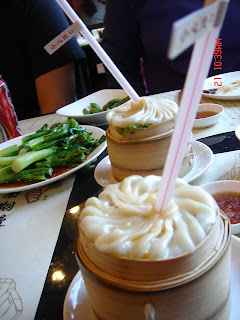


Traffic was just as bad (if not worse) than in Beijing. People seemed more aggressive, especially when we were in crowded situations like at the Bund or Yuyuan, which during the holiday season, was thronged, and I mean THRONGED, with visitors. It was literally push-and-shove in order to make ones way through to ones destination.

The crowd at Yuyuan
ATTRACTIONS
The city definitely looked more developed than BJ. Walking along the Bund, we noticed that one side of the Huang Pu River had architecture reminiscent of its colonial days, while across the river, modern buildings were the norm.

The "old"side of the Huangpu River

The modern side of the Huangpu river
The Shanghai maglev train is another example of modernization. We did a round trip on this train for the sake of our kids...after all, how often does one get to ride in a train at 430 km/h?!

Shanghai Maglev train
FOOD!
One does not visit Shanghai & not rave about the food! From fine Italian cuisine (read: expensive) at Cucina on the 56th floor of the Grand Hyatt in Pudong, to different varieties of buns at a Mantou restaurant in Yuyuan, to delicious (& greasy!) shenjian mantou costing us only 70 yuan for 72 buns which the 9 of us devoured, one can find an amazing variety of food available in the city. The pig's elbows ("tipang") is a must. Don't be turned off by the layer of wobbly fat & skin that you see on the surface. Underneath all that, you find the tasty lean braised pork meat...mmm...yummy...

"Souper" buns at Yuyuan

Shenjian mantou - delicious & cheap!

Braised pig elbows "tipang"
Impressions from China - New Year
(Written 12 MN, Feb 17/18,2007)
I gaze out of the bedroom window of our service apartment overlooking downtown Shanghai. The cityscape is covered in a haze created by a combination of fog and smoke from burning fireworks & firecrackers.
Right, left and centre, we seem to be surrounded by rainbow-colored shooting stars exploding to an incessant continuous cacophony of snaps, crackles & booms - explosive retorts from exploding fireworks. It seems neverending, this noise & light show that is welcoming in the Lunar New Year.
I am fascinated by this city, a seemingly foreign & Western Hub in an ancient Oriental country. It reminds meof Hong Kong & Malacca & Penang & Singapore all rolled into one. I look forward to exploring more.
The fireworks are still going off as I write this...and it looks like the city is not going to sleep...not tonight anyway...
Thursday, February 15, 2007
Gung Hei Fatt Choy
I dreamt of my dearly departed grandmothers last night. The images are vague, as dreams tend to be. I remember snatches of the dream, images of my maternal grandma, my mom & I shopping along Orchard Road, taking shelter from the drizzling rain along the five-foot way near Peranakan Place just outside the Taka jewelry store. What we were shopping for, I don’t know.
Then the dream shifted to my paternal grandmother, urging me to make the booking for a cruise or a hotel or some kind of holiday online before it became all sold out! This is totally radical as my Ah Mah never had an inkling of how to use a computer!
Since time immemorial, people have wondered about dreams & their meanings. I won’t even begin to go into that. What the dream did for me was to evoke memories of Chinese New Year shared with those who are no longer with us, New Year celebrations when extended families were actually in the same country. New Year’s Eve would see us having dinner together: grandparents, uncles, aunts, cousins. We would pre-arrange the sequence of ‘visitations’ (actually, my beloved but dictatorial maternal grandpa would be the logistician), & even co-ordinate what kind of food we would have at each house so that there would be no overlap!
The morning of New Year’s Day would dawn with my siblings & I waking up, wishing our parents “gung hei fatt choi” & eagerly receiving hong baos from them. We would then dress in our new clothes & head out to the first stop, usually my maternal grandparent’s home. That would mark the start of a whole day of stuffing ourselves silly, mahjong, & for the kids, totaling up the hong bao takings (not necessarily in that order).
I know many people complain about the monotony & tedium of having to visit all their relatives year after year after year. To those people I say: Appreciate what you have when you have it because one day, you’ll wake up missing & wishing for those days.
I know I do.
Gung Hei Fatt Choi/Gong Xi Fa Cai/Happy Chinese New Year everyone!
Wednesday, February 14, 2007
Impressions from China - This & That
Been here over a month. Can't say I totally feel at home yet, but things are slowly & surely falling into place.
Our immune systems have been challenged. In total, the 4 of us have suffered from 5 bouts of URTI, & 4 bouts of GI-related illnesses in the short time that we've been here. Not fun, but I guess our resistance against new bugs has to be built up.
Chinese New Year is coming up & we're off to Shanghai to visit with some friends. People here get a whole week off for the "chun jie"(Spring Festival), as they call it here. Many return to their home towns & villages, & apparently bus & train tickets are impossible to get this week.
The tid bits I see being sold in supermarkets are not much different from those sold in Singapore. One big difference is that fireworks are allowed to be sold here for the weeks around CNY. We have already started hearing the booms of firecrackers being lit at night; I think this will escalate & peak on New year's Eve & the first few days of the New Year.
Another difference I see is that there is no "yusheng" here. Shouldn't be surprised though, since I think that is a Singaporean "invention".
Gong Xi Fa Cai everyone!
Wednesday, February 07, 2007
Numbers
Disclaimer: The opinion expressed in this entry is solely that of aliendoc’s, based on experience in both public & private sector. It in no way reflects policies or opinions of the Powers That Be.
There has been much discussion the last few weeks about MOH making it “easier” for foreign doctors to practise in Singapore. This is supposed to address the shortage of doctors in the country.
There have been arguments & questions raised on why & whether there is actually a shortage at all, especially in the private sector. No, I don’t believe that there is a shortage; it’s a dog eat dog world out there especially in GP-land*. (*I exclude aesthetic practitioners in this group, as I believe they are a different species from what one would perceive as a typical GP…but then, that is whole different kettle of fish altogether ☺. I also exclude doctors who are employees of a larger medical group – this will be expounded upon later.)
Doctors are not businessmen. We were not taught a module on business strategies & economics in medical school. Hence, GP’s end up “killing” each other trying to get a “market share” of patients. They undercut, sign on with HMO’s & MHC’s (whatever you may call it, these 3rd party administrators exist for the sole purpose of making money) just to make ends meet. Business consultants would probably cringe if they saw the kind of decisions that have been made by some of these doctors.
As for the larger medical groups, it’s a different story altogether. Speak to any of their operations managers or HR manager & you would probably discover that recruiting & retaining doctors is a difficult task. Many have a high turnover rate; take a look at the SMA newsletter & you’ll see what I mean - ads repeated issue after issue, seeking doctors to join them.
On the flip side, you have the government polyclinics – obviously overcrowded & evidently understaffed. Junior doctors in hospitals are also lacking (although this may have improved the last few years with increasing medical school intake).
So why the shortage in the government sector? Simple: doctors leave after they complete their obligatory bond. And why do they leave? Perhaps they seek the almighty $. Or they want some autonomy in how they practise. Or they are just sick of the bureaucracy. Like it or not, there is still a strongly hierarchical structure (not to mention the politics!) in the government departments (call it NHG or Singhealth, call it what you like, but in the end, it works the same way ☺). It is hard to be heard unless you go through the proper channels (i.e. somewhat of an obstacle course where you have to clear a few obstacles before reaching the finish line, if at all).
And how would you explain the medical groups’ dilemma of finding & keeping doctors? My take is that doctors working for these groups have very little say (if at all) in how certain patients (read: those under very restrictive HMO/MHC contracts) are managed. After all, these groups have to answer to their shareholders & clients (note: I use the word "clients", not "patients") & the bottom line is VERY important after all (sarcasm intended). So, see as many patients as possible, get as many contracts as possible, & save money for the clients (the companies who contract with them to look after their employees). End result is that doctors will use this as a stepping-stone, a temporary job before they venture out on their own to compete with their colleagues for patients, and the vicious cycle continues.
So will letting in more foreigners in do the job of resolving the numbers problem? Probably partially & temporarily, especially in the government sector & in the medical groups. But it won’t help the GP’s out there who will still be struggling to stay afloat, competing with each other, & forced to charge miniscule amounts for consultation fees.
So if the big wigs want to look at the long term problem of shortage (I prefer to use the word, skewed distribution) of doctors, they will need to examine the causative problems first. Otherwise this will just be another fire-fighting scheme, which does not prevent another fire from starting.
Impressions from China - Aliens
As an alien in China, you begin to appreciate the difficulties that foreign workers meet with when they leave the comfort (not neccesarily just physical, but psychological & emotional as well) of home. A strange new language, different transportation systems, electricity voltages/sockets, customs & culture...when one is inundated by a shock wave of all things new & unfamiliar, it can be extremely daunting. The simple task of shopping for groceries or neccesities in a store takes twice as long when one is trying to interpret the labels on a can/bottle/package.
I have met with many foreigners in the last month that we've been here, hailing from the various continents. It is weirdly comforting to know that no matter where we're from or what our mother tongue, we all share the same stories of fumbling & learning our way around an alien country. I guess being in a foreign land makes our differences seem insignificant in the greater scheme of things.
We have the advantage of accessibilty to information & resources like the Internet & guide books to help us settle in. But most of the manual foreign workers who travel thousands of miles from home searching for a better life do not have that. They rely on sometimes unscrupulous agents & employers to "help" them in their expatriation. And yes, by definition, they are expats too.
So the next time you see a foreign worker ,who labours to help us build those skyscrapers & condos, or who helps you to look after your home, take care of your children/parents, spare them a kind thought & put yourself in their place. After all, once upon a time, most of our ancestors were expatriates too.
Thursday, February 01, 2007
Battlestar Galactica
I’ve been glued to the sci-fi series “Battlestar Galactica”. Not the old series from the 70’s, but the revamped one that has been playing on the SciFi channel in the USA since 2003. I bought Season 1, 2 & 2.5 & brought all 3 sets here, in expectation of a relatively barren TV listing in China (which I am now happy to report is not that bad after all ☺).
I was a huge fan of the original series (probably, in great part, due to my crush on Dirk Benedict who played brash, cigar-chomping ace pilot, Starbuck). Star Wars: A New Hope started off my fascination with the scifi genre. When BG came along, it became a favorite of mine. Looking back, I suppose that during my adolescent years was also when my mind started to question if there was something out there in the Universe; after all, statistically speaking, in our humongous universe, there has to be other worlds with intelligent life-forms apart from our big blue marble.
The new series is definitely different from the old. A lot darker for one, & despite its setting, delves into current day issues - war, terrorism, abortion, racism, torture of prisoners (season 2, rated NC-16, addresses the latter & had me cringing at some of the scenes).
With brilliantly written scripts & great acting by veterans Edward James Olmos (Commander Adama) & Mary McDonnell (President Laura Roslin), & relative newcomers Jamie Bamber (Capt Lee “Apollo” Adama), Katee Sackhoff (Lt. Kara “Starbuck” Thrace), Grace Park (Cylon sleeper agent Lt. Sharon “Boomer” Valerii) & Tricia Helfer (as the babelicious Cylon No. 6/Gina), I have been watching episodes from the series avidly in the last week, going through season 1 & now seasons 2 & 2.5 (don’t ask me why they divided season 2 up). Grace Park especially deserves special mention in season 2 with all the heart-wrenching emotions she must have had to drag up from the depths of her soul in order to portray her character’s situation so adeptly.
Season 3 is being broadcast now in the USA. I can’t wait for the DVD set to be released (or at least for the series to start showing on Cinemax).
Monday, January 29, 2007
Passport, please
I have no gripes against Singapore accepting more foreign-trained doctors into the country to practice medicine. If standards are in place to ensure that these doctors are adequately trained, & able to practice good medicine (whether as a GP or as a specialist), I think we should welcome them.
What I feel strongly about is the double standards that SMC seems to have for Singaporean foreign-trained doctors & non-Singaporean foreign-trained doctors. What one’s nationality is should not play a part in deciding whether one is fit to practice or not.
Why just a pre-requisite 2 years of conditional registration (for a Singaporean) as opposed to 6 years for a foreigner (according to current guidelines on the SMC website)? It used to be just one year for Singaporeans. The 6 year conditional registration for foreigners will be changed to 4 years as announced by Minister Khaw last week.
Still, why the discrepancy? Is it assumed that Singaporeans trained overseas are better than foreigners trained overseas?
I can understand that SMC may want to “protect” its own citizens. But when it comes to the practice of medicine, who will protect the patients & ensure that they receive proper medical care no matter which country the doctor may come from?
Friday, January 26, 2007
Impressions from China - Market Day
I am so happy I have found a wet market in Beijing! Somehow, FFV's* in supermarkets don't cut it for me. So when a neighbour (a fellow newcomer with similarly unconventional life experiences as me - originally from HK, married to American, have lived in US, then Suzhou/Shanghai & now Beijing) brought me to not one, but two wet markets on Wednesday, I was so happy! I found my leafy greens & fruits which don't look dehydrated/manhandled like the ones you find in Carrefour or Walmart (yes, they have a Walmart here). And prices were cheap too. I bought chicken legs/breast, pork ribs/loin, siew bak choy ,water cress, dou miao, ginger, apples, Chinese pear, watermelon, mandarin oranges (the mini ones which are intensely sweet - yum), mango & paid the princely sum of about 100 yuan** in total.
The northern Chinese don't eat a lot of leafy greens, for some reason. They mostly like gourds & beans & peppers in their food. Hence, one finds it difficult to find things like choi sum & kai lan in the supermarkets (local or otherwise). Well, you do see them occasionally in the aforementioned supermarkets, but most are wilted & not something I would use to cook.
Yay! Now I won't miss my Holland V vegetable ladies & Farrer market fruit man too much!
*fresh fruits & vegetables
**approx. SGD20 or US$14
Thursday, January 25, 2007
Impressions from China - Grey
Grey.
That seems to be the predominant color in Beijing. In the almost 4 weeks that we've been here, we've woken up to grey skies most days. The number of days that I've actually seen clear blue skies can be counted on the fingers of one hand.
Driving into the city on the highway, one sees a shroud of grey haze enveloping the cityscape. Even the trees are grey. The "evergreens" are a sickly dark greyish green in color.
I don't remember the winters in Pennsylvania being so grey. I recall blues & greens even in the dead of winter.
It's like everything is waiting for Mother Nature's magic wand to wave away the dreary greyness, & breathe life & color into everything again.
I await with bated breath.
Wednesday, January 24, 2007
For all the Mothers out there...
I received this from a friend. I usually delete chain mails, but I couldn't resist putting this up...
JUST A MOM?
A woman, renewing her driver's license at the County Clerk's office, was asked by the woman recorder to state her occupation.
She hesitated, uncertain how to classify herself.
"What I mean is," explained the recorder, "do you have a job or are you just a ...?"
"Of course I have a job," snapped the woman.
"I'm a Mom."
"We don't list 'Mom' as an occupation, 'housewife' covers it," said the recorder emphatically.
I forgot all about her story until one day I found myself in the same situation, this time at our own Town Hall.
The Clerk was obviously a career woman, poised, efficient, and possessed of a high sounding title like, "Official Interrogator" or "Town Registrar."
"What is your occupation?" she probed.
What made me say it? I do not know. The words simply popped out.
"I'm a Research Associate in the field of Child Development and Human Relations."
The clerk paused, ballpoint pen frozen in midair and looked up as though she had not heard right.
I repeated the title slowly emphasizing the most significant words. Then I stared with wonder as my pronouncement was written, in bold, black ink on the official questionnaire.
"Might I ask," said the clerk with new interest, "just what you do in your field?"
Coolly, without any trace of fluster in my voice, I heard myself reply, "I have a continuing program of research”, (what mother doesn't),
“In the laboratory and in the field”, (normally I would have said indoors and out).
“I'm working for my Masters”, (first the Lord and then the whole family)
“and already have four credits” (all daughters).
“Of course, the job is one of the most demanding in the humanities” (any mother care to disagree?),
“and I often work 14 hours a day”, (24 is more like it).
“But the job is more challenging than most run-of-the-mill careers and the rewards are more of a satisfaction rather than just money."
There was an increasing note of respect in the clerk's voice as she completed the form, stood up, and personally ushered me to the door.
As I drove into our driveway, buoyed up by my glamorous new career, I was greeted by my lab assistants -- ages 13, 7, and 3. Upstairs I could hear our new experimental model, (a 6 month old baby) in the child development program, testing out a new vocal pattern.
I felt I had scored a beat on bureaucracy! And I had gone on the official records as someone more distinguished and indispensable to mankind than "just another Mom."
Motherhood! What a glorious career! Especially when there's a title on the door.
Does this make grandmothers "Senior Research associates in the field of Child Development and Human Relations"?
And great grandmothers "Executive Senior Research Associates?"
I think so!!!
I also think it makes Aunts "Associate Research Assistants."
Sunday, January 21, 2007
Impressions from China - Counting Sheep & Blessings
On the way to dinner a couple of nights ago, we saw three flocks of sheep grazing on the side of the road, watched over by shepherds...sheep, I tell you! As my sons "oooh"ed & "ah"ed over this sight, I turned to them & said, "How random is that???!"
But on second thought, I figured that in China, this wouldn't be a 'random' occurence, & it shouldn't have surprised me; the same way how seeing mules still being used for pulling cartloads of goods/cargo shouldn't have surprised me either (we saw this while visiting one of the schools we were considering for our boys).
This country is such a unique blend of the old & the new, the urban & the rural, the rich & the poor, the East & the West. There is such a disparate difference between how & where people live.
The Shunyi district where we are is filled with "compounds" comprising of "villas" mostly occupied by foreigners & the well-off Chinese. These compounds usually have their own clubhouse with amenities like indoor/outdoor pools, gyms, restaurants, even spas on their premises. The houses are equipped with washers & dryers & dishwashers, satellite TV links & internet access.
Interspersed within this district, I see single level homes clustered together like a large village. From what I can see from the road, these buildings have sparsely furnished rooms, darkly lit, a single bed inside, laundry hanging on a line outside. These are occupied by local labourers & "migrant" workers who leave their rural villages to become "ayi"*s or manual laborers or taxi drivers in the greater Beijing area.
Truly an eye-opener for us.
*ayi = domestic helper
Friday, January 19, 2007
Impressions from China - I'm homesick
Yes, I miss my family, my friends.
But I also miss the efficiency of Singapore. There are so many procedures (many seemingly pointless) in place for the most simple things. Asking for a receipt (fapiao) here is a big deal especially for large items like furniture. Receipts here actually have a scratch off portion that tells you whether you have won money or not; it's the governments attempt at encouraging the public to ask for official receipts which retailers have to submit. This is their way of trying to stamp out under-declaring by the retailers.
I miss being able to look at road signs & know immediately what it says & where I am heading to.
I miss being able to say something to someone without having a puzzled look of incomprehension being returned to me.
I miss my vegetable seller in Holland V who helps me choose my veges for a great price.
I miss being able to drink water off the tap without wondering whether I am ingesting carcinogenic toxins into my system.
I miss being billed for gas & electricity. They use top up cards here for gas & electricity, for crying our loud!!! So if we forget to check the meter, we may end up sitting in the dark one night.
I know these are growing pains in the fledgling days of our time here. It will get better. It will.
Tuesday, January 02, 2007
Winter Wonderland
Winter is, putting it simply, very very cold. We all have romantic visions of snow-covered landscapes & tree branches encrusted in ice resembling jewels sparkling in the sun amidst blue blue clear skies.
Well, yeah, you do see that once in a while, but more often than not, the snow becomes grey with road dust & mud, cars become splattered with dirty snow, & sometimes salt, walkways become a hazard when the melted snow freezes over into ice & the landscaped is covered by a cloud of grey fog. With the short days & long nights, it is no wonder that people get S.A.D. (Seasonal Affective Disorder).
Good thing is that children still see winter through the rainbow glasses of innocence. Snow is something to look forward to & to play & frolic in. Catch a snowflake on your tongue! Walk in the snow instead of the cleared paths! Would that I could recapture that magical feeling!
Sunday, December 31, 2006
...and we have touchdown...
Well, we are finally here. We landed in minus 3 degree Celsius weather under hazy conditions on a Friday night. As we disembarked, the first thing that hit me (apart from the frigid cold) was the smell of smoky fumes. Don't know if this was from emissions from the plane engine or the parking garage of the airport or from the famed pollution I've heard so much about...but I think air filters will definitely be a must in our new home.
We are in a serviced apartment for now until our new home is ready for us to move into in a couple of weeks.
No homesickness yet, however, saying farewell is never easy, especially to family members. That familiar cliche: 'Home is where the Heart is' is so true. Although I have my husband & children with me, part of my heart will always be with my other family: parents, sister, brother, best friends.
I have been nursing a cold the last couple of days, something I picked up during our last few days in warmer climes (no, one doesn't catch cold from, cold weather, thank you very much!). The dryness & cold here don't help my symptoms a lot, making my nasal & throat passages feel terribly uncomfortable especially compounded by taking antihistamines to stop the continuous sneezing & nasal discharges. Been trying to load up on fluids too - no need for silica gel here (humidifiers will be another must-have in our new home).
Hence my present entry at the unearthly hours of 5 a.m. in the morning...having been woken up by a very dry mouth (having to breathe through my mouth since my nasal passages are clogged up) & mild attack of asthma. No worries, I am fine - nothing that 4 mg of Ventolin can't fix. My good ol' trusty medicine pouch has served me well; it's something I always travel with - my own form of personal insurance, one may call it.
Ok, I am going to go read a bit, & allow the Ventolin to kick in & hopefully go back to sleep for a few more hours .
Weather aside, my first impression of BJ has been a good one - the people seem to be warm & friendly, very willing to help, and with customer service that beats Singapore. It has made this alien feel very welcome.
More later.
Sunday, December 24, 2006
Thursday, December 14, 2006
Zai4 Jian4*
*
Chinese for farewell
Well, my trusty ol' computer will be lovingly packed away tonight by my husband in preparation for our move.
I will continue blogging when/if I can during the interim. Once we are settled, I hope to write about the trials & tribulations & hopefully, joys of life in China as an "alien".
Ouch
Oooooh....I feel a tidal wave of reactions coming in response to this letter in today's Straits Times:
"Dec 14, 2006
'Hua Yu cool'? No, boorish Mandarin-speaking youths spoil the image
I can attest that Mr Peter Donkin's observations of young Singaporeans are true. I have many negative opinions of young Singaporeans too, despite being a youth myself.
My observations of inconsiderate behaviour among young Singaporeans almost always involve the Mandarin-speakers. While not implying that all Mandarin-speaking youths are rotten (nor are all English-speaking youth angels), an overwhelmingly large group of offenders are observed to be from this group.
This seems to stem from the Chinese school of thought which advocates 'If I don't take, I lose out' and 'If others can do it, so can I, otherwise I lose out', among other factors.
Before anyone takes offence at my discrimination, go on a MRT ride across the island first, and my theory will come to life.
On a train ride from Jurong East to City Hall last month, I saw three groups of Mandarin-speaking youths huddled with their handphones playing Chinese songs at full blast.
The three groups were in the same cabin. It was terrible. One couple left the cabin for another because they couldn't take the racket.
Many people glared at the youths. A girl from one of the groups declared in Mandarin and English 'Wa, wo men hen attract attention leh!', which translates to 'Wow, we are attracting a lot of attention!'.
Was she thinking that people saw her group as 'cool' just because her handphone played MP3 music and they were the latest Mandopop hits? I was outraged at the inconsiderate behavior.
The Mandarin-speaking Singaporean youths also seem to ignore rules that make the world an orderly place. For example, they ignore repeated reminders to keep to the left on escalators. They also ignore the markings that serve to allow passengers on trains to alight first.
A Malaysian classmate who recently visited Thailand spoke of how gracious the people there were, and their good etiquette on the train.
Step into a shop and you will notice that the Mandarin-speakers are rude to service staff and they never say 'please' or 'thank you'.
Based on their interactions with my peers, they take offence easily,
yet they have no qualms about being sarcastic and rude to foreign teachers.
Many young litterbugs are also Mandarin-speaking youths. When I visited Melbourne some months back, I was greatly impressed at the clean streets. I saw everyone putting their litter into bins, and there were no cleaners around.
While many Mandarin-speaking youths are nice on a personal level, their mentality can manifest the antisocial behaviour that I have mentioned.
My friends and I belong to the minority English-speaking
group and we are ashamed to speak in Mandarin in public. No, we are not elites, just normal teenagers.
Unless the association of bad behaviour with Mandarin-speaking youths can be negated, 'Hua Yu Cool' isn't going to work on us anytime soon.
Ang Lixing"
A rather unfair generalisation on the part of Ms Ang, I feel. There are boors in all segments of society, no matter what language they speak.
However, I must say that this boorish behaviour she describes is becoming more prevalent locally. It's the Me generation - forget about proper & appropriate CIVILISED behaviour.
Pity.
Thursday, December 07, 2006
Supermom
There is a loud resounding silence as far as response to this letter is concerned.
Dec 2, 2006
Mothers deserve more support from Govt
I READ the articles under the heading, 'Disparate housewives' (The Sunday Times, Nov 26), with much interest.
I am a housewife by choice, having previously worked as sales support manager for a US-China joint venture after completing my Master of Science degree. I also have an MBA.
When our first son was born nine years ago, my husband and I decided that I would give up my career to be a full-time mother/housewife. This decision drew sneers from well-meaning relatives and friends, while my parents thought I was wasting my education and talents.
We now have four lovely children. Motherhood is truly a sacrificial and demanding task but I have no regrets. No childcare service can replace the mother. Mother is often the best caregiver and teacher.
However, what bothered me is the inconsistency in government policy. When I applied recently for permanent residency for my parents, the Immigration and Checkpoints Authority (ICA) rejected my application with the statement, 'You may wish to submit another application for our consideration after you are gainfully employed for a period of time.'
Does the Government think that full-time mothers are not gainfully employed? As reported, stay-at-home mothers/housewives contributed approximately 8 per cent of Singapore's GDP, not counting the long-term impact on Singapore's future. This has been clearly documented in academic-research finding after finding worldwide, including Nanyang Technological University Associate Professor Euston Quah's findings, as was also reported.
Since around 1999, the Government has been actively encouraging Singaporeans to have more babies, offering baby bonuses and tax rebates in the face of a declining and fast-ageing indigenous population.
While one can understand the Government's wish at the same time to encourage mothers to return to the workforce, a policy conflict-of-interests and dilemma is inadvertently created.
The future of Singapore is in mothers' hands. It takes commitment, patience and, above all, sacrificial love to nurture children, for the future of the country.
The letter I received from ICA was a true dampener. Should not mothers deserve more support and understanding from the Government?
He Ruo Fan (Ms)"
I guess one of the spin doctors in ICA is trying to craft a response that
a) empathises with Ms He's sentiments that SAHM's are important in the process of child-rearing;
b) will support the Government's call to have more babies;
c) calls for more companies to be more pro-family so that more SAHM's can return to work at least part-time (like being a mother is not work???);
d) will also support the Government's call for women to return to the workforce.
Maybe the silence from the general public is because many Singaporeans feel that housewives/full time moms don't really have a job? Forget about the night calls (i.e. night feeds/diaper changes for infants), nursing (i.e.sick child/sick husband), chaffeur (i.e. driving kids to/from school & activities), housekeeper (i.e. housework), accountant (i.e. keeping track of household accounts & making sure bills are paid), cook (self-explanatory), teacher (i.e. reading to kids/revision/helping them with assessments), COO (of the household). Oh, and also you cannot take MC as no one will be able to take over your duties, and also no vacation days either, for the most part.
Tuesday, December 05, 2006
Friendship
As the date of our departure encroaches, I find myself reflecting on what Friendship is, & how hard it is to find True Friends. In our new home in a foreign country, making friends is something I think of with some trepidation. Will it be easy? When one is far away from one's extended family, friends are such important & valuable commodities to have.
"Friends are relatives you can choose." I heard this somewhere that I can't recall at the moment. How true it is though. True friends are hard to come by. In my lifetime (so far), I have met so many different kinds of people & made different kinds of friends.
True Friends
These are the ones I have known from childhood or college. There are a couple whom I met as an adult, & despite being separated by continents, still consider ourselves dear friends. These are people whom I can share comfortable silences with - no need for small talk.
Good Friends
These are friends whom I feel comfortable chatting with, & who have gone through similar experiences (eg. Medical school classmates). When we meet, there are no awkward silences; we eagerly catch up with each other's lives & occasionally organise get-togethers to maintain this friendship.
Social Friends
These are the ones whom I may meet at various social gatherings or school functions. We may smile & nod at each other, then, if we happen to be seated next to each other at the table, are able to strike up a fairly interesting conversation about common topics like current affairs or the school system or medical cases (if they happen to be fellow doctors). Apart from these events, we would probably never see each other ever again.
It's a mystery to me how a friendship forms. Why is it that Person A can become one's closest friend while Person B, who may exactly the same interests as you, can not?
When I first moved away from Singapore to the US, I was petrified that I would be alienated, being a foreigner & all. This proved to be unfounded fears as I found a group of people in my neighbourhood who eventually became my Good Friends.
Returning here, I thought that I would be able to make more new friends, this being my home country after all. My True Friends have, needless to say, remained close, & we literally picked up where we left off. I also resumed contact with some Good Friends & made a few new Good & Social Friends along the way.
However, making new friends hasn't been as easy as I thought. Neighbours here tend to keep to themselves (at least the ones that I have had). At work, my life experiences although enriching, have made me into a strange amalgamation of being a local with a foreign "twist". In my kids' school, where foreign parents are abundant, I realised that befriending some of them is not as easy as it looks, as people still tend to be cliquish when they are in a foreign community...which leaves me sandwiched somewhere between the "locals" & the "foreigners". Plenty of Social Friends to be had, but hard to find Good Friends; & True Friends?....virtually impossible.
So I hope that in our new adventure in China, there will be more Good Friends to be made. If I am lucky, I may even find a True Friend.
Thursday, November 30, 2006
A chocolate a day keeps the doctor away
Good news for fellow chocolate lovers out there!
This article from Medscape shows promising results that eating chocolate may have the same effect as taking an aspirin a day!
"Chocolate Has Antithrombotic Effects Similar to Aspirin"
Martha Kerr
November 17, 2006 (Chicago) — Subjects enrolled in the Genetic Study of Aspirin Responsiveness (GeneSTAR) inadvertently helped Johns Hopkins University researchers measure chocolate's inhibition of platelet function and show that eating chocolate slows clotting time. The findings may explain how chocolate and cocoa-containing foods exert a cardioprotective effect.
A group of 139 healthy individuals did not eliminate chocolate from their diet.
Senior investigator Nauder Faraday, MD, associate professor of anesthesia and critical care medicine at Johns Hopkins University in Baltimore, Maryland, told Medscape that "chocolate was just one of those things this group couldn't give up."
The subjects were ejected from GeneSTAR proper and were not randomized in the aspirin assessment phase of the study. But Dr. Faraday and colleagues took advantage of the subjects' noncompliance to assess chocolate's previously demonstrated role in cardiovascular risk reduction, using the same platelet function analyzer test employed in the GeneSTAR study.
The investigators measured agonist-induced platelet activation in the presence of shear and calculated time to closure in the system by a platelet plug. Platelet activation was also assessed on urinary excretion.
Chocolate consumption caused a significant increase in time to closure, but remained within the normal range, the investigators announced here this week at the American Heart Association 2006 Scientific Sessions.
"Chocolate, even in small amounts, was an independent factor in inhibition of platelet activation," Dr. Naraday said. It extended closure time, regardless of age, sex, smoking status, body mass index, systolic blood pressure, total cholesterol level, fibrinogen levels, or von Willebrand factor.
"The magnitude of the effect was quite small," Dr. Naraday emphasized. Chocolate had the same type of effect as aspirin, but by a factor of 5 to 10 times less, according to the assay used in the GeneSTAR study, he said.
Elliott Antman, MD, professor of medicine at Harvard University in Cambridge, Masssachusetts, told Medscape that he found the results intriguing. "It might help explain the tremendous variability among patients to platelet inhibition, particularly as seen in response to aspirin."
Dr. Naraday pointed out that "any time you shift the balance away from thrombosis, you set up a situation with the potential for increased bleeding time and other risks, but I don't think this is a big problem with eating chocolate!"
Dr. Faraday's study is funded by the National Heart, Lung, and Blood Institute of the National Institutes of Health. Dr. Antman reports no relevant financial relationships.
AHA Scientific Sessions 2006: Abstract 4101. Presented November 14, 2006.
Subscribe to:
Posts (Atom)